HookMesh vs qtrl.ai
Side-by-side comparison to help you choose the right tool.

Effortlessly ensure reliable webhook delivery with automatic retries and a self-service portal for your customers.
Last updated: February 27, 2026

qtrl.ai
qtrl.ai scales QA testing with AI agents while ensuring full team control and governance.
Last updated: March 4, 2026
Visual Comparison
HookMesh
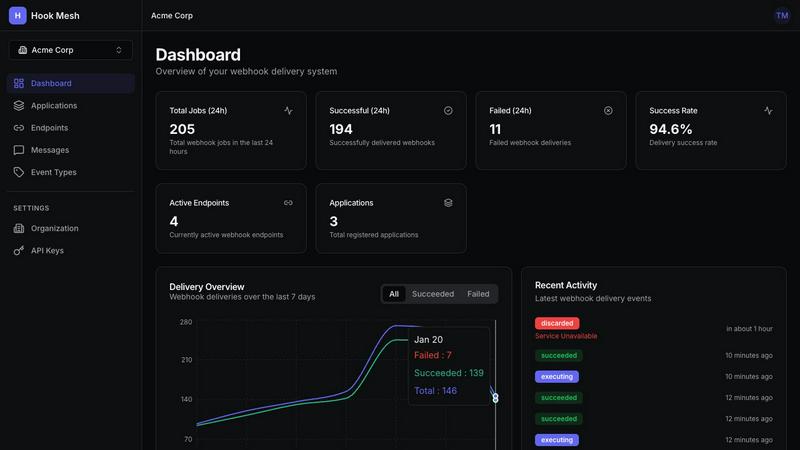
qtrl.ai
Feature Comparison
HookMesh
Reliable Delivery
HookMesh guarantees that no webhook is ever lost. It employs automatic retries with exponential backoff and jitter, retrying for up to 48 hours to ensure successful delivery. This means your webhook events will reach their destination, even in the face of temporary network issues or endpoint failures.
Customer Portal
With HookMesh's embeddable UI, your customers can manage their webhook endpoints efficiently through a self-service portal. This feature enhances user experience by providing full request and response visibility, allowing customers to monitor their webhook performance and manage their settings autonomously.
Automatic Circuit Breaker
HookMesh includes a proactive circuit breaker feature that automatically disables failing endpoints to prevent cascading failures. Once the endpoint recovers, it can be re-enabled automatically, ensuring that your webhook delivery remains robust and uninterrupted.
Developer Experience
Designed with developers in mind, HookMesh offers a comprehensive REST API and official SDKs for popular programming languages like JavaScript, Python, and Go. This enables quick integration, allowing developers to ship webhook events in minutes with just a few lines of code.
qtrl.ai
Enterprise-Grade Test Management
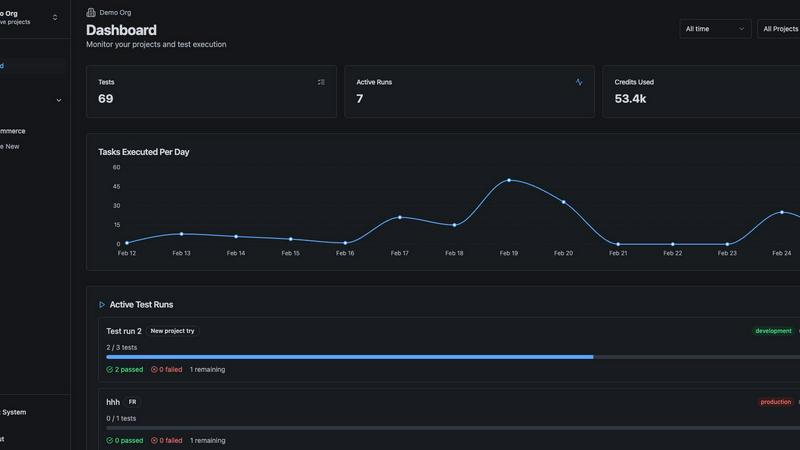
qtrl provides a centralized, structured foundation for all QA activities. Teams can create and organize test cases, plan comprehensive test runs, and establish full traceability from requirements to test coverage. Real-time dashboards offer clear visibility into quality metrics, showing exactly what has been tested, pass/fail statuses, and potential risk areas. This manual and automated workflow management is built with compliance and auditability as first principles, ensuring teams never lose oversight.
Progressive AI & Autonomous QA Agents
Instead of a risky "black-box" AI takeover, qtrl introduces intelligent automation progressively. Teams begin by writing high-level test instructions in plain English, which qtrl's agents execute precisely. As trust builds, teams can leverage AI to generate full test scripts from descriptions and maintain them as the application evolves. These autonomous agents operate within defined rules, executing tests on-demand or continuously across multiple environments at scale, using real browsers—not simulations.
Adaptive Memory & Intelligent Suggestions
The platform builds a living, evolving knowledge base of your application through every interaction—exploration, test execution, and issue discovery. This Adaptive Memory powers context-aware test generation that becomes more effective over time. Furthermore, qtrl proactively analyzes coverage gaps and suggests new tests to fill them, transforming the QA process from reactive maintenance to intelligent, continuous quality improvement.
Governance by Design & Multi-Environment Execution
qtrl is built for enterprise trust, with transparency and control embedded in its architecture. It offers permissioned autonomy levels, full visibility into agent actions, and enterprise-ready security. For execution, it supports running tests across any environment (dev, staging, production) with per-environment variables and encrypted secrets. Critically, these secrets are never exposed to the AI agent, ensuring security is never compromised for the sake of automation.
Use Cases
HookMesh
E-commerce Notifications
E-commerce platforms can utilize HookMesh to send real-time order notifications to customers. By ensuring reliable delivery of events such as order confirmations and shipping updates, businesses can enhance customer engagement and satisfaction.
SaaS Integrations
SaaS products can leverage HookMesh to facilitate seamless integrations with third-party applications. By managing webhook delivery efficiently, businesses can ensure that important events trigger necessary actions in connected systems, improving overall workflow.
Payment Processing
Payment processors can depend on HookMesh for delivering transaction notifications to merchants and customers. By guaranteeing the reliability of these crucial events, businesses can build trust and ensure timely updates regarding payment statuses.
System Monitoring
Companies can implement HookMesh to send alerts and notifications from their monitoring systems. This ensures that any critical system events, such as outages or performance issues, are communicated promptly to the relevant teams, enabling quick responses to mitigate potential disruptions.
qtrl.ai
Scaling Beyond Manual Testing
QA teams overwhelmed by repetitive manual test cycles can use qtrl to systematically scale their efforts. They start by structuring their existing manual cases in the test management hub for better visibility. Then, they progressively automate the most tedious, high-value UI workflows using plain English instructions, freeing up human testers for more complex exploratory work and significantly accelerating release cycles without a steep learning curve.
Modernizing Legacy QA Workflows
Companies relying on outdated, siloed, or script-heavy automation frameworks can modernize without a disruptive rip-and-replace project. qtrl integrates with existing tools and CI/CD pipelines, allowing teams to bring their current processes into a centralized platform. They can then incrementally augment or replace brittle scripts with AI-generated tests that are easier to create and maintain, building a more resilient and efficient QA ecosystem over time.
Governing Enterprise AI Testing
For large organizations in regulated industries that require strict compliance, audit trails, and governance, qtrl provides a safe path to AI adoption. Its permissioned autonomy, full audit logs of all agent activities, and "no black-box" policy ensure that AI augments the QA process without introducing unpredictable risk. Engineering leads can grant automation capabilities while retaining ultimate approval and control over what tests run and what changes are made.
Empowering Product-Led Engineering Teams
Product-focused engineering teams that need to move fast but maintain high quality can embed qtrl into their development lifecycle. Developers can write high-level test instructions for new features, and qtrl handles the execution, providing immediate feedback. The platform's coverage analysis and test suggestions help ensure no regression is introduced, enabling faster, more confident deployments aligned with a product-led growth strategy.
Overview
About HookMesh
HookMesh is a groundbreaking solution that streamlines webhook delivery for modern SaaS products, addressing the common challenges faced by developers and product teams. It alleviates the burdens of building webhooks in-house, such as implementing complex retry logic, managing circuit breakers, and debugging delivery issues. By utilizing HookMesh, businesses can concentrate on their core offerings without getting entangled in the technical intricacies of webhook management. The platform boasts a robust infrastructure that ensures reliable delivery through features like automatic retries, exponential backoff, and idempotency keys. Ideal for developers and product teams, HookMesh helps deliver a seamless experience for customers while maintaining consistent and reliable webhook event delivery. With its self-service portal, HookMesh empowers users to manage endpoints, gain visibility into delivery statuses, and replay failed webhooks with ease, making it the preferred choice for organizations aiming for a worry-free webhook strategy.
About qtrl.ai
qtrl.ai is a modern, progressive QA platform designed to solve the critical scaling challenges faced by software teams today. It bridges the frustrating gap between the slow, unscalable nature of manual testing and the brittle, expensive complexity of traditional test automation. qtrl uniquely combines robust, enterprise-grade test management with powerful, trustworthy AI automation, all within a single, governed platform. Its core value proposition is enabling teams to scale their quality assurance efforts without ever sacrificing control, visibility, or governance. Teams start with a centralized hub for organizing test cases, planning runs, tracing requirements, and tracking real-time quality metrics. From this foundation of clarity and control, they can progressively introduce intelligent automation. qtrl's autonomous agents can generate and maintain UI tests from plain English, executing them at scale across real browsers and environments. This makes it the ideal solution for product-led engineering teams, QA groups moving beyond manual processes, companies modernizing legacy workflows, and any enterprise that requires strict compliance, full audit trails, and a trusted path to faster, more intelligent quality assurance.
Frequently Asked Questions
HookMesh FAQ
What type of events can I send with HookMesh?
You can send any JSON payload representing webhook events using HookMesh. This flexibility allows you to tailor the events according to your specific business needs.
How does HookMesh handle failed deliveries?
HookMesh employs automatic retries with exponential backoff and includes an idempotency key feature to ensure that events are delivered at least once, even when initial delivery attempts fail.
Is there a limit on the number of webhooks I can send?
Yes, HookMesh offers different pricing tiers that specify the number of messages you can send per month. The free tier allows 5,000 webhooks per month, while higher tiers offer increased limits.
Can I test my webhooks before going live?
Absolutely! HookMesh provides a playground feature that enables developers to test and debug webhook events before deploying them in a live environment, ensuring smooth operation from the start.
qtrl.ai FAQ
How does qtrl.ai ensure control and governance over AI actions?
qtrl is built with governance as a core design principle. It does not operate as a black box. Teams set permission levels for autonomy, and all AI-generated tests or actions are fully reviewable and require human approval before implementation. The platform provides complete visibility into every action an autonomous agent takes, maintains full audit trails for compliance, and allows teams to define the exact rules and boundaries within which the AI operates.
Can qtrl.ai integrate with our existing development tools and CI/CD pipeline?
Yes, qtrl is designed to fit into real-world engineering workflows. It offers integrations for requirements management and seamless support for CI/CD pipelines. This allows teams to trigger automated test suites as part of their build and deployment processes, enabling continuous quality feedback loops. qtrl works alongside your existing toolchain to enhance it, not replace it forcibly.
Is my application data secure, especially when using AI agents?
Absolutely. qtrl employs enterprise-grade security measures. A key feature is the secure handling of sensitive data: per-environment variables and encrypted secrets (like login credentials) are managed securely and are never exposed to the AI agents. The agents execute tests without accessing the underlying secret values, ensuring that your most sensitive data remains protected while still enabling automated testing.
What if we are not ready for full AI automation? Can we still use qtrl?
Yes, this is a fundamental strength of qtrl's progressive approach. You can start using it solely as a powerful, structured test management platform to organize manual test cases and plans. You can then introduce automation at your own pace, beginning with simple, human-written instructions for the agent to execute. The AI capabilities are there to leverage when you are ready, allowing you to start simple and scale intelligence over time.
Alternatives
HookMesh Alternatives
HookMesh is a cutting-edge solution tailored for enhancing webhook delivery within SaaS applications. It simplifies the complexities involved in managing webhooks, such as retry logic, debugging issues, and ensuring reliable delivery. As businesses increasingly rely on seamless data integration, users often search for alternatives to HookMesh due to factors like pricing, specific feature requirements, or compatibility with existing platforms. When exploring alternatives, it’s essential to consider aspects such as reliability, ease of use, customer support, and the ability to manage webhook events without technical bottlenecks. --- [{"question": "What is HookMesh?", "answer": "HookMesh is a platform designed to streamline webhook delivery for SaaS products, offering features like automatic retries and a self-service customer portal."},{"question": "Who is HookMesh for?", "answer": "HookMesh is ideal for developers and product teams seeking a reliable solution for managing webhook events without the complexities of in-house management."},{"question": "Is HookMesh free?", "answer": "HookMesh offers various pricing plans, and interested users should check the official website for specific details on costs."},{"question": "What are the main features of HookMesh?", "answer": "Key features of HookMesh include reliable delivery with automatic retries, a self-service customer portal, at-least-once delivery, and a focus on enhancing the developer experience."}]
qtrl.ai Alternatives
qtrl.ai is a modern QA platform in the automation and dev tools category. It helps software teams scale testing by combining structured test management with trustworthy AI agents, offering a controlled path to intelligent automation. Users often explore alternatives for various reasons. These can include budget constraints, the need for a different feature set, or specific platform requirements like deeper integration with an existing toolchain. The search for the right fit is a normal part of the software selection process. When evaluating options, consider your team's primary goals. Look for a solution that balances powerful automation with the governance and control your processes demand. The ideal platform should grow with you, providing a clear path from manual testing to scalable, AI-assisted quality assurance without becoming a black box.