Iphone Phone House vs Miget
Side-by-side comparison to help you choose the right tool.
Iphone Phone House
Control and scale your iPhone fleet with secure, low-latency access to dedicated physical devices.
Last updated: April 13, 2026
Miget
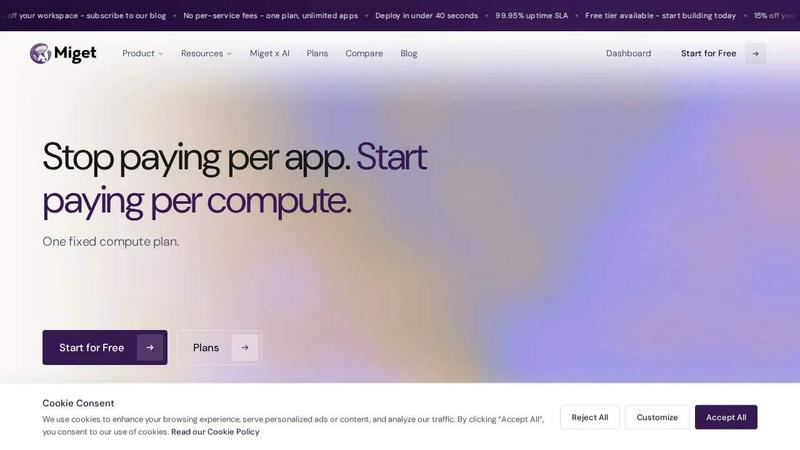
Miget offers one flat-rate plan to deploy unlimited apps with no per-service fees, saving you money.
Last updated: April 13, 2026
Visual Comparison
Iphone Phone House

Miget
Feature Comparison
Iphone Phone House
Bare-Metal Device Streaming
iPhone Phone House provides direct, low-latency access to physical iPhones, not software simulations. Utilizing a global edge-optimized remote protocol, users experience sub-50ms interaction latency, enabling real-time control for touch, gestures, and app usage. This ensures genuine iOS behavior, including accurate GPU rendering and sensor responses, which is critical for reliable testing and authentic user interactions that emulators cannot replicate.
Complete Session Telemetry & Control
The platform offers unparalleled visibility and oversight for every device session. Operators can monitor live screens in real-time, and all sessions are fully recorded with comprehensive activity logs. This creates a complete audit trail, detailing who accessed which device and what actions were performed. Combined with remote lock/kill switch capabilities, it gives administrators total control to secure operations and ensure accountability.
Enterprise-Grade Security Architecture
Security is foundational, not an add-on. iPhone Phone House employs a zero-trust access model with dedicated device pools for each client, ensuring no hardware or environments are shared. All data streams are end-to-end encrypted, and access is governed by strict role-based controls and network restrictions. This architecture eliminates risks from credential sharing and uncontrolled personal devices.
AI-Driven Visual Automation
Teams can build and execute sophisticated automations directly on the real iPhones without needing to install SDKs or modify app code. This AI-driven visual automation capability allows for the scaling of repetitive tasks—like app testing or social media interactions—by recognizing on-screen elements and performing actions, drastically reducing manual labor and human dependency while ensuring compatibility with the actual iOS environment.
Miget
Unlimited Services Per Plan
This is the cornerstone of Miget's value proposition. Once you choose a compute plan, you are not limited in the number of applications, databases (like PostgreSQL or Redis), or background workers you can deploy within its resource boundaries. This eliminates the fear of "service sprawl" costing you hundreds of dollars extra per month. You can experiment freely, build microservices, and create preview environments without ever seeing a per-service fee on your invoice, leading to truly predictable and often significantly lower costs.
GitHub-Native Deployments & Preview Apps
Miget integrates deeply with your GitHub workflow for a zero-friction deployment experience. Simply connect your repository, and every push to your main branch triggers an automatic production deployment. More powerfully, every pull request automatically generates a full-stack, isolated preview environment with its own unique URL. This includes your app, its database, and environment variables, allowing for thorough testing in a production-like setting without any manual configuration or extra cost.
Managed Databases Inside Your Plan
Unlike traditional PaaS that charge separately for data services, Miget includes managed databases like PostgreSQL, MySQL, and Valkey (a Redis-compatible store) as part of your compute allocation. There is no extra billing line item for adding a database to your application. This simplifies your stack management and cost forecasting, ensuring that building a full-featured application with persistent storage doesn't break your budget.
Full-Stack Cloning & Instant Redeploys
Miget empowers rapid development and testing with its one-click cloning feature. You can clone an entire application, including its database schema and data, to create a perfect replica for debugging, feature development, or staging. Combined with intelligent build caching (via Migetpacks that auto-detect your stack), this results in incredibly fast deployment times—often under 40 seconds—for both initial deploys and subsequent redeploys, dramatically improving developer velocity.
Use Cases
Iphone Phone House
Large-Scale App Testing & QA
Development and QA teams can test their iOS applications across multiple real iPhone models and iOS versions simultaneously. This eliminates the "it works on the simulator" problem by catching device-specific bugs, performance issues, and UI glitches that only appear on genuine hardware, leading to higher-quality app releases and faster development cycles.
Social Media & Growth Operations
Marketing and social media teams can securely manage multiple business or client accounts from a centralized, compliant platform. By using real devices, they avoid detection and blocking algorithms that target emulators and automated tools, ensuring sustainable account growth, content scheduling, and community engagement through authentic device fingerprints.
Mobile Device Management (MDM) & Support
IT and support departments can remotely access and troubleshoot company-managed iOS devices or demo units without physical handling. This allows for efficient software updates, configuration checks, and user support sessions, reducing downtime and logistical complexity while maintaining a clear audit trail of all administrative actions.
Automated Workflow Execution
Businesses can automate repetitive mobile-centric workflows such as data validation, multi-app processes, or compliance checks. By running these automations on real iPhones via the visual automation engine, companies achieve reliable execution at scale, freeing human operators for higher-value tasks and ensuring processes run 24/7 without error.
Miget
Indie Hackers & Solo Founders
For solo developers building and launching products, Miget is ideal. It provides the simplicity of a traditional PaaS for easy deployment but with the crucial advantage of fixed, predictable pricing. An indie hacker can deploy their main application, a separate admin panel, a PostgreSQL database, a Redis cache, and multiple background workers for tasks like email processing—all under a single, affordable monthly plan, avoiding the complex and expensive billing of other platforms.
Growing Startups with Microservices
As a startup scales from a monolith to a microservices architecture, costs on per-service platforms can skyrocket. Miget allows engineering teams to decompose their application into multiple, isolated services (APIs, frontends, workers) and deploy them all within one compute plan. This enables architectural best practices and scaling without the corresponding financial penalty, keeping infrastructure costs predictable and manageable during growth.
Agency & Client Project Development
Development agencies managing multiple client projects benefit immensely from Miget's model. Each client project can be deployed as its own set of services within the agency's compute plan. The ability to spin up full-stack preview environments for every PR is perfect for client reviews and approvals. This setup consolidates infrastructure management and costs, providing clarity and control over all client work from a single dashboard.
Enterprise Development & Internal Tools
Large organizations can use Miget to host a vast array of internal tools, dashboards, and APIs. Teams can innovate and deploy new tools without requiring separate budget approvals for each new service, as they all fall under the organization's existing compute allocation. Features like team roles, audit logs, and support for custom domains/VPCs make it suitable for enterprise-grade security and compliance requirements.
Overview
About Iphone Phone House
iPhone Phone House is a revolutionary infrastructure platform that solves the fundamental challenge of operating genuine iOS devices at a business scale. It provides remote, real-time access to a fleet of physical iPhones hosted in secure, global data centers. This eliminates the need for companies to purchase, manage, and maintain their own hardware, transforming iPhones from fragile, physical assets into reliable, scalable operational infrastructure. The platform is designed for businesses whose operations depend on authentic iOS environments, offering ultra-low latency streaming that allows for full touch, gesture, and camera interaction just as if the device were in hand. By replacing unreliable emulators and insecure personal devices with a controlled, auditable environment, iPhone Phone House empowers teams in social media management, app development, QA testing, and automation to execute workflows with greater speed, security, and oversight. Its core value proposition is delivering the uncompromised behavior of real Apple hardware with the scalability and control of enterprise-grade cloud software.
About Miget
Miget is a modern Platform-as-a-Service (PaaS) that fundamentally rethinks cloud pricing and developer experience. It solves the core financial problem with traditional platforms like Heroku, where every new application, database, or background worker adds a separate, recurring charge to your bill. This per-service model stifles innovation, punishes architectural experimentation, and turns infrastructure into a constant budgeting headache. Miget flips this model on its head. Instead of paying for each component, you select a fixed compute plan based on the resources you need (like CPU and RAM). Within that reserved capacity, you can deploy an unlimited number of services—web apps, APIs, managed PostgreSQL databases, Redis instances, and background workers—all for one predictable monthly price. Built on robust, isolated Kubernetes infrastructure, Miget offers a seamless, production-ready workflow with GitHub-native deployments, automatic TLS, custom domains, and preview environments for every pull request. It’s designed for everyone from indie hackers and solo developers launching side projects to growing startups and enterprises that need to scale their microservices architecture without unpredictable cost explosions. With Miget, you only pay for the compute you reserve, not the number of things you build on it.
Frequently Asked Questions
Iphone Phone House FAQ
How is this different from an iOS simulator or cloud emulator?
iPhone Phone House provides access to real, physical iPhones with genuine Apple silicon, while simulators are software approximations that run on Macs. Emulators often exhibit non-human behavioral patterns, have higher latency, and cannot replicate true sensor or GPU performance. Our solution offers the exact behavior of a consumer iPhone, which is essential for reliable testing and operations that must appear authentic.
What kind of latency can I expect when controlling a device?
The platform is built on a global edge-optimized network designed to deliver an average interaction latency of less than 50 milliseconds (ms) worldwide. This ultra-low latency ensures that touch responses, scrolling, and interactions feel instantaneous, making the remote experience virtually indistinguishable from holding the physical device.
Is my data and access secure on the platform?
Yes. Security is architected into the core of the service. We implement a zero-trust model with dedicated hardware per client, end-to-end encrypted streaming sessions, and granular role-based access controls (RBAC). There is no sharing of devices or environments between customers, and all network access can be restricted via IP whitelisting for enterprise clients.
Can I automate tasks on these remote iPhones?
Absolutely. iPhone Phone House includes a powerful AI-driven visual automation engine. This allows you to create and run automated workflows directly on the real devices by visually recognizing screen elements. You can automate complex sequences of actions without the need for code modifications or installing special SDKs in your apps.
Miget FAQ
How does pricing work if services are unlimited?
Miget operates on a capacity-based model. You select a monthly compute plan that reserves a specific amount of CPU and memory resources (e.g., 2 vCPUs, 4GB RAM). You can deploy as many apps, databases, and workers as you want, as long as their collective resource usage stays within the limits of your chosen plan. You pay for the plan, not per individual service, making your bill simple and predictable.
What happens if I exceed my plan's compute resources?
If your collection of services begins to use more CPU or memory than your plan includes, Miget's infrastructure will throttle performance to stay within your allocated limits to avoid overage charges. To maintain optimal performance, you would need to upgrade to a larger compute plan. This model gives you clear cost control and prevents surprise bills from unexpected traffic spikes or resource leaks.
Are the databases truly production-ready?
Yes. The managed databases (PostgreSQL, MySQL, Valkey) offered within your Miget plan are not lightweight containers; they are fully managed, durable services with automated backups, failover, and patches. They run with the same isolation and reliability guarantees as your applications, making them suitable for production workloads without the management overhead or extra cost.
How does the preview environment feature work?
When you create a pull request on GitHub, Miget automatically detects it. It then builds your application from the feature branch, provisions an isolated copy of its linked database (with schema but optionally without production data), and deploys everything to a unique, temporary URL. This creates a complete, functional preview of the changes for testing and review. Once the PR is merged or closed, the preview environment and its resources are automatically cleaned up.
Alternatives
Iphone Phone House Alternatives
Iphone Phone House is a service in the remote device access category, providing businesses with on-demand, low-latency control of real physical iPhones hosted in secure data centers. It allows teams to interact with genuine iOS hardware remotely for tasks like app testing and social media management, eliminating the need for physical device fleets. Users often explore alternatives for several key reasons. Budget constraints may lead them to seek more cost-effective solutions, while specific technical needs might require different feature sets, such as support for Android devices or specialized automation tools. Some teams may also prioritize different aspects like user interface design, integration capabilities with their existing software stack, or specific compliance certifications. When evaluating alternatives, focus on core requirements. Essential factors include the authenticity of the device environment compared to emulators, the reliability and speed of the connection, and the robustness of security measures. Also, consider scalability to support your team's growth and the depth of native iOS functionality access, such as camera control and gesture support, which are critical for authentic testing and operations.
Miget Alternatives
Miget is a platform-as-a-service (PaaS) solution that simplifies deploying web applications, databases, and background workers. It operates on a unique flat-rate compute model, allowing you to deploy unlimited services within your chosen plan instead of paying per individual app or database. Users often explore alternatives for several reasons. The primary driver is pricing structure; some projects outgrow per-service billing, leading to unpredictable costs. Others may require specific features, integrations, or a different level of control over their infrastructure that their current platform doesn't provide. When evaluating other platforms, consider your core needs. Focus on the pricing model's predictability, the ease of deployment and management, and whether the platform offers the essential managed services like databases and automatic TLS. The goal is to find a solution that scales with your project's complexity without complicating your budget or workflow.