APIMCP.dev vs Quitlo
Side-by-side comparison to help you choose the right tool.

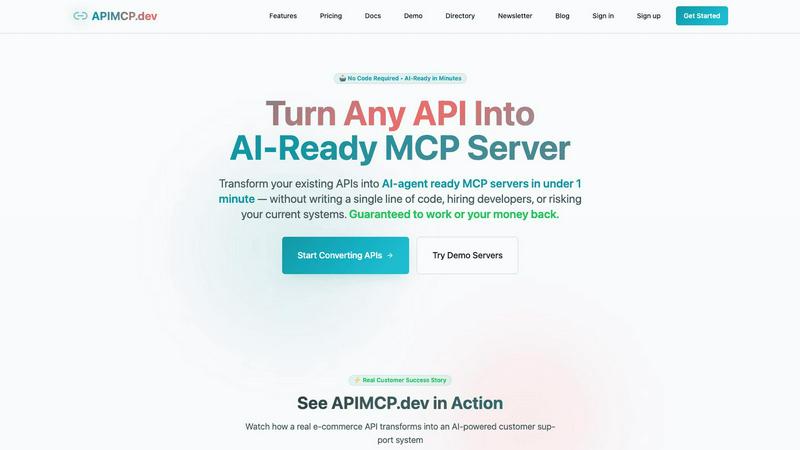
APIMCP.dev
Instantly turn any REST API into an AI-ready MCP server without writing code.
Last updated: March 1, 2026

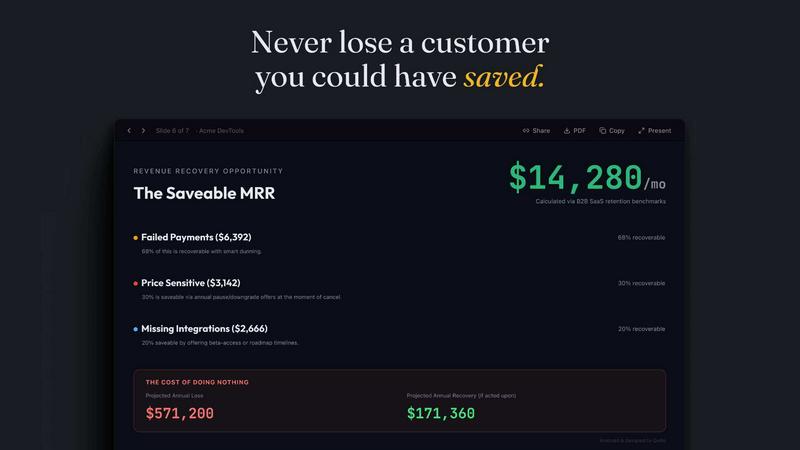
Quitlo uses AI voice calls to uncover the real reasons customers leave, then delivers the full story to your team.
Last updated: March 4, 2026
Visual Comparison
APIMCP.dev
Quitlo
Feature Comparison
APIMCP.dev
One-Minute MCP Server Generation
The platform's core intelligence lies in its instant conversion engine. Simply provide your API's OpenAPI specification and authentication details. Within 60 seconds, the system analyzes the spec, understands endpoints and data structures, and generates a complete, AI-agent ready MCP server. This feature completely bypasses weeks of development work, turning a complex coding project into a simple, automated process that requires no programming knowledge from the user.
Built-in Enterprise Security & Authentication
APIMCP.dev ensures your core systems remain protected. The platform handles authentication seamlessly, integrating your existing API keys, OAuth flows, or other security protocols directly into the generated MCP server. The AI agents interact with the MCP layer, not your backend directly, creating a secure abstraction. This architecture guarantees that your live systems are never exposed or at risk while still providing AI agents with the authorized access they need to perform tasks.
No-Code, Developer-Friendly Interface
Designed for product managers and developers alike, the interface requires zero coding. The entire workflow—from connecting your API to deploying the MCP server—is managed through a straightforward web interface. For developers, it eliminates tedious boilerplate code, allowing them to focus on higher-value tasks. For non-technical users, it democratizes access to advanced AI agent capabilities, making powerful integrations possible without a deep technical background.
Real-Time Analytics & Performance Monitoring
Gain immediate visibility into how your AI agents are interacting with your APIs. The platform provides a dashboard to monitor MCP server usage, track AI agent interactions, analyze response times, and view system performance metrics. This feature is crucial for understanding utilization, optimizing workflows, and ensuring reliability, giving you data-driven insights into the performance and impact of your newly enabled AI integrations.
Quitlo
Adaptive AI Voice Conversations
Quitlo's core feature is its AI that conducts real, two-minute voice conversations with customers at critical moments. Unlike a static form, this AI engages in a dynamic dialogue, asking intelligent, empathetic follow-up questions based on the customer's initial response. This method captures the full context and nuance behind a cancellation or negative signal, turning a one-word answer into a complete story that teams can act upon.
Automated Signal Detection & Triggering
The platform seamlessly integrates with your stack to automatically detect key churn signals without manual intervention. It monitors for events like a subscription cancellation, a low NPS/CSAT score, a failed payment, or a customer going quiet after onboarding. When a signal is detected, Quitlo instantly triggers the appropriate engagement, ensuring no critical moment for understanding or recovery is missed.
Structured, Actionable Intelligence Delivery
Within minutes of a conversation, Quitlo synthesizes the dialogue into a clear, structured summary delivered to tools like Slack, Jira, or your CRM. This summary breaks down the churn reason, customer sentiment, any competitor mentions, and—critically—a quantified save opportunity with a suggested next action. This turns raw conversation data into an immediate, tactical play for your team.
Five Integrated Engagement Entry Points
Quitlo provides a unified AI conversation engine across five key customer lifecycle moments: Cancel Flows, Surveys (NPS/CSAT), Payment Recovery, Post-Onboarding Check-Ins, and Win-Back campaigns. This means you get consistent, deep intelligence whether a customer is canceling, giving a low score, or has already left, all from a single platform.
Use Cases
APIMCP.dev
AI-Powered Customer Support Automation
Transform an e-commerce or CRM API into an intelligent support agent. An AI tool like Claude can use the generated MCP server to directly answer customer queries about order status, inventory levels, or account details in real-time. For example, a customer can ask, "Where is my order #12345?" and the AI agent automatically calls the GET /api/orders/12345 endpoint via the MCP server to fetch and relay the live shipping status, providing instant support without human intervention.
Internal Business Intelligence & Data Querying
Empower team members to interact with complex internal data systems using natural language. Connect APIs from databases, ERP, or project management software. Employees can then ask an AI agent questions like, "What were our Q3 sales figures for the EMEA region?" or "List all high-priority bugs," and the agent will retrieve the information directly from the live systems through the MCP server, acting as an intelligent, conversational data analyst.
Rapid Prototyping of AI-Enhanced Products
Startup founders and product teams can quickly prototype and validate AI features. Instead of spending months building custom integrations, they can use APIMCP.dev to instantly connect their MVP's API to an AI agent. This allows for rapid testing of concepts like an AI shopping assistant, a smart content moderator, or an automated data entry bot, significantly accelerating the innovation cycle and time-to-market for new AI-powered offerings.
Streamlining Developer Workflows with AI
Developers can supercharge their IDE (like Cursor) by connecting it to internal development APIs. With an MCP server for their project management, version control, or deployment APIs, they can use natural language to perform tasks: "Create a new Jira ticket for the login bug," "Deploy the staging branch to AWS," or "Fetch the last 10 commits from the main branch." This turns the AI into a powerful, context-aware assistant that can execute commands across the development toolchain.
Quitlo
Replacing Ineffective Exit Surveys
B2B SaaS teams using tools like Delighted, Retently, or Survicate often get low-response-rate surveys with unhelpful one-word answers. Quitlo replaces these by triggering an AI voice conversation after a low score or cancellation. This directly addresses the problem, engaging the customer in a dialogue that reveals the "why" behind the score, providing actionable insights instead of vague data.
Recovering At-Risk Customers During Cancellation
When a customer initiates cancellation, a static dropdown form offers no chance to save them. Quitlo's smart cancel widget can present dynamic offers and, most importantly, invite the customer into a quick AI conversation. This real-time engagement can uncover the true barrier (e.g., "I'd stay with team pricing") and identify immediate, high-probability save opportunities before the churn is finalized.
Understanding and Acting on Payment Failures
A failed payment is often a silent churn signal. Instead of sending generic dunning emails, Quitlo automatically engages the customer via voice or text to understand the reason. It could be a budget freeze, a switch to a competitor, or a simple card update. This intelligence allows the finance or CS team to take the correct, personalized action to recover the revenue.
Conducting Proactive Post-Onboarding Check-Ins
Customers who go silent after onboarding are at high risk of eventual churn. Quitlo can be configured to automatically check in with these customers via a friendly AI conversation. This proactive engagement helps identify confusion, lack of adoption, or unmet expectations early, allowing teams to intervene with guidance and support before dissatisfaction sets in.
Overview
About APIMCP.dev
APIMCP.dev is a revolutionary, no-code platform that solves a critical bottleneck in the modern AI development workflow: connecting AI agents to existing software systems. The core challenge is that powerful AI tools like Claude, Cursor, and ChatGPT cannot natively interact with traditional REST APIs. Manually building the necessary Model Context Protocol (MCP) servers to bridge this gap is a complex, time-consuming process that can take an experienced developer 40 to 80 hours of intricate coding, authentication handling, and documentation parsing. This creates a significant barrier for product managers, startup founders, and developers who need to rapidly empower their AI workflows with live data and functionality without jeopardizing their current systems or hiring specialized MCP developers.
APIMCP.dev eliminates this entire development cycle. It automatically transforms any REST API with an OpenAPI specification into a fully functional, production-ready MCP server in under 60 seconds. The platform's main value proposition is delivering enterprise-grade, secure API connectivity for AI agents at a fraction of the traditional cost and time. It is built for professionals who need guaranteed, rapid results, offering a seamless way to unlock the potential of AI agents by giving them direct, safe access to internal tools, customer data, and business logic. By removing the technical complexity, APIMCP.dev allows teams to focus on creating innovative AI-powered applications and automations instead of wrestling with integration code.
About Quitlo
Quitlo is the first Churn Intelligence Platform built specifically for B2B SaaS companies. It solves the critical and frustrating problem of losing customers without understanding why. Traditional methods like exit surveys and cancel forms are broken, offering dismal response rates and one-word answers like "pricing" that provide no actionable insight. This leaves teams guessing in the dark, unable to save at-risk revenue or learn from departures. Quitlo replaces these static, ineffective tools with adaptive, empathetic AI conversations conducted via both voice and text. The platform automatically detects key customer signals—such as a cancellation, a low NPS score, a failed payment, or post-onboarding silence—and initiates a genuine two-minute dialogue. Its intelligent AI asks contextual follow-up questions to uncover the complete, nuanced story behind the churn signal. Within minutes, Quitlo delivers a structured, actionable summary directly to tools like Slack or Jira, highlighting the exact churn reason, customer sentiment, competitor mentions, and clear save opportunities. For product, customer success, and growth teams tired of losing customers they could have saved, Quitlo transforms a single, vague data point into a concrete retention strategy, helping you preserve revenue and truly understand what drives customer decisions.
Frequently Asked Questions
APIMCP.dev FAQ
What is an MCP server and why do I need one?
The Model Context Protocol (MCP) is a standard that allows AI applications like Claude Desktop to securely connect to external data sources and tools. An MCP server acts as a translator and bridge between the AI agent and your specific API. Without it, AI tools cannot understand or interact with your REST APIs. APIMCP.dev builds this essential bridge for you automatically, making your APIs comprehensible and usable by AI agents.
What do I need to provide to generate an MCP server?
You need two key pieces of information: your API's OpenAPI specification (also known as Swagger docs) and your authentication details. The OpenAPI spec is a standard, machine-readable document that describes your API's endpoints, request/response formats, and parameters. Most modern APIs have this available. You also provide how your API is secured (e.g., an API key, OAuth credentials), which APIMCP.dev securely integrates into the generated server.
Is my API data and authentication secure?
Yes. Security is a foundational principle. Your authentication credentials are handled with enterprise-grade security practices. The generated MCP server acts as a secure proxy; the AI agent only talks to the MCP server, not your backend API directly. This architecture ensures your core systems remain insulated. Furthermore, you maintain full control and can revoke access or rotate keys at any time through your original API provider.
Which AI tools and agents are compatible?
APIMCP.dev generates standard-compliant MCP servers that are compatible with any AI application supporting the Model Context Protocol. This includes popular tools like Anthropic's Claude Desktop, Cursor IDE, ChatGPT with MCP capabilities, and other emerging AI agent platforms. The servers provide the tools and context these agents need to understand and execute your API's functions seamlessly.
Quitlo FAQ
How is Quitlo different from traditional survey tools?
Traditional survey tools like Delighted or Survicate only tell you what a customer scored (e.g., a low NPS). They provide almost no context on why. Quitlo is fundamentally different: it uses AI-driven voice conversations to engage customers who give low scores or cancel. This dialogue uncovers the full story, including sentiment, competitor moves, and specific save opportunities, delivering actionable intelligence rather than just a metric.
What if a customer doesn't want to talk to an AI?
The invitation to an AI conversation is always optional. Quitlo is designed to be empathetic and non-intrusive. The initial engagement is a simple, polite request for a quick two-minute chat. If a customer declines, the platform can still collect information via a smart text-based flow. The goal is to provide a better alternative to forms, not to force an interaction.
How does the AI know what questions to ask?
Quitlo's AI is built specifically for churn intelligence in B2B SaaS. It starts with a core question based on the trigger (e.g., "What made you decide to cancel?") and then dynamically asks intelligent, context-aware follow-up questions based on the customer's response. It is trained to probe for specifics on pricing, competitors, features, and processes to build a complete narrative.
Can we use Quitlo if we're currently using Delighted?
Yes, absolutely. Quitlo is a direct and powerful replacement for Delighted, especially with its impending shutdown. It captures all the survey and feedback data Delighted did but enhances it dramatically with AI voice follow-up capabilities. The platform offers a seamless migration path and even provides a free three-month period for teams transitioning from Delighted.
Alternatives
APIMCP.dev Alternatives
APIMCP.dev is a no-code platform in the productivity and management category that instantly transforms REST APIs into AI-ready MCP servers. Users often explore alternatives for various reasons, such as budget constraints, specific feature requirements not covered, or needing a solution that integrates with a different technology stack or development workflow. When evaluating other options, it's crucial to assess several key factors. Consider the total implementation time and technical expertise required, as manual coding can be prohibitively expensive. The platform's approach to security and authentication for API connections is also paramount. Finally, evaluate the solution's ability to accurately translate API capabilities into tools that AI agents can reliably understand and use.
Quitlo Alternatives
Quitlo is an AI-powered Churn Intelligence Platform designed for B2B SaaS companies. It moves beyond ineffective surveys by using adaptive voice and text conversations to uncover the real reasons behind customer churn, delivering actionable insights directly to teams. Users may explore alternatives for various reasons, such as budget constraints, a need for different integration capabilities, or a preference for a platform with a broader or narrower feature focus than Quitlo's specialized churn analysis. When evaluating other solutions, consider the core problem you need to solve. Look for tools that go beyond simple data collection to provide genuine customer understanding, ensure seamless delivery of insights to your team's workflow, and ultimately help convert feedback into concrete retention actions.