
Interactive Circle of Fifths vs Polym
Side-by-side comparison to help you choose the right tool.

Interactive Circle of Fifths
Visualize and master music theory effortlessly with our Interactive Circle of Fifths for scales, chords, and.
Last updated: March 1, 2026

Polym uses cognitive science to help you actively remember essential knowledge through audio courses and flashcards.
Last updated: March 1, 2026
Visual Comparison
Interactive Circle of Fifths
Polym
Feature Comparison
Interactive Circle of Fifths
Interactive Circle
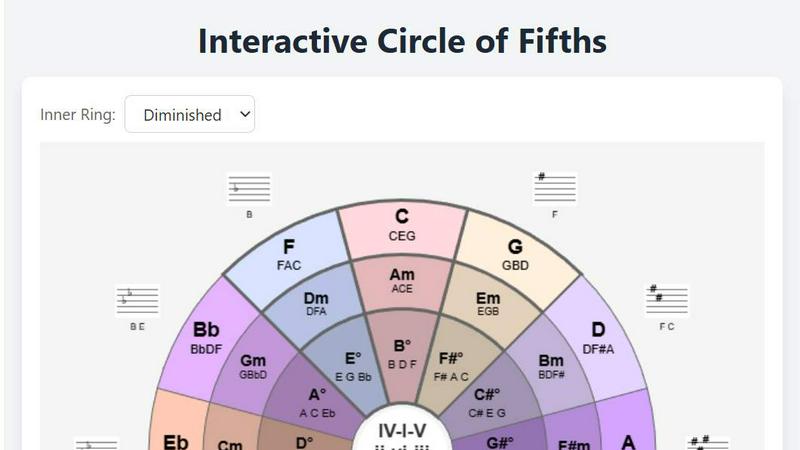
The core feature of the Interactive Circle of Fifths is its dynamic, clickable visual representation of the circle. Users can engage with different keys, chords, and scales, allowing for an immersive experience that encourages exploration and experimentation. This interactivity demystifies music theory and helps users understand how various elements relate to one another.
Instrument-Specific Visualizers
The tool includes dedicated visualizers for piano and guitar, which display chord shapes and scale patterns unique to each instrument. This feature allows users to visualize how chords and scales translate into finger placements, bridging the gap between theoretical knowledge and practical execution.
Harmonized Scale Panel
With the Harmonized Scale panel, users can explore how different scales are constructed and their related chords. This feature enhances understanding of diatonic harmony, making it easier for musicians to create progressions that sound cohesive and pleasing. It serves as a practical guide for songwriters and composers.
Chord Sequencer
The Chord Sequencer allows users to experiment with different chord progressions in real-time. Musicians can select chords from the circle and hear them in context, facilitating a deeper understanding of how harmonic movement works. This interactive approach encourages creativity and helps users discover new musical ideas.
Polym
Medium-Form Audio Courses on Foundational Subjects
Polym offers expertly crafted, medium-length audio courses on a wide array of essential subjects. The challenge with dense topics like logic or statistics is their complexity, but Polym solves this by distilling them into digestible audio narratives. These courses focus on abstract concepts and practical examples, carefully tailored for the audio format to ensure clarity and engagement without requiring visual aids. This feature provides a structured yet flexible way to build foundational knowledge across disciplines relevant to both professional and personal growth.
Active Learning with Retrieval Practice
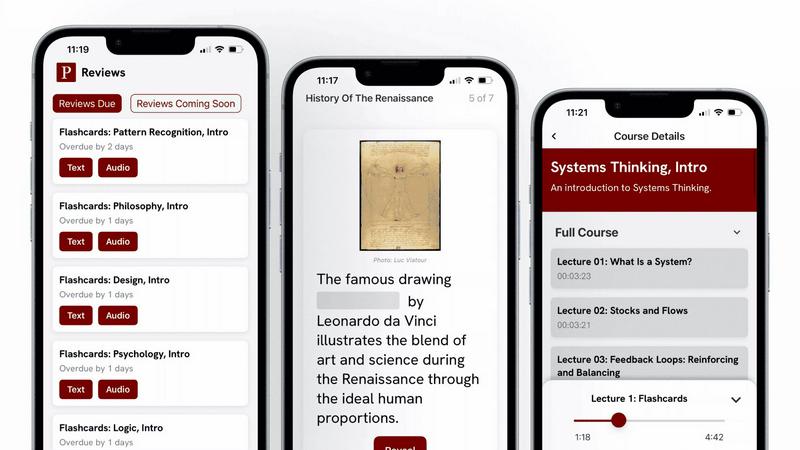
Moving beyond passive listening, Polym actively engages your brain to combat forgetting. The app incorporates retrieval practice, a powerful technique where you are prompted to actively recall information from memory. This is implemented through interactive audio flashcards and quiz-like prompts within courses. The challenge of passive learning is weak retention; Polym's solution is to make you the active participant in your learning, strengthening neural connections every time you successfully retrieve a concept, leading to significantly improved long-term recall.
Spaced Repetition Scheduling
Polym tackles the "cram and forget" cycle by intelligently scheduling review sessions. The app's algorithm uses spaced repetition, prompting you to revisit key material at strategically increasing intervals. The problem is that memories fade without reinforcement. Polym's solution is to systematically bring information back to you just as you're about to forget it, cementing it more firmly into long-term memory with each review. This automated scheduling ensures your study time is optimized for maximum retention efficiency.
Interleaved Learning Sessions
Instead of studying one topic in isolation, Polym mixes related concepts from different subjects in its practice sessions. The challenge of blocked practice is that it can lead to superficial learning that doesn't transfer well. Polym's interleaving feature solves this by presenting problems and concepts from, for example, statistics and economics in a mixed sequence. This forces your brain to discern subtle differences and strengthens your ability to apply knowledge flexibly across various contexts, building deeper, more connected understanding.
Use Cases
Interactive Circle of Fifths
Learning Music Theory
Beginners can utilize the Interactive Circle of Fifths to learn the basics of music theory in a hands-on manner. By engaging with the circle, they can understand key signatures, chord relationships, and scale structures without feeling overwhelmed by traditional methods.
Songwriting Assistance
Songwriters can leverage the tool to find new chord progressions and harmonies for their compositions. By experimenting with the Chord Sequencer and harmonized scales, they can create unique and interesting musical pieces, gaining inspiration from the immediate auditory feedback.
Improvisation Practice
Musicians looking to improve their improvisational skills can use the Interactive Circle to explore different scales and chords in real-time. The auditory feedback helps users identify which notes work well over specific chords, enhancing their ability to improvise fluidly and confidently.
Teaching Resource
Music educators can incorporate the Interactive Circle of Fifths into their teaching curriculum to make lessons more engaging. The tool’s interactive features provide a visual and auditory way to explain complex concepts, making it easier for students to grasp and retain information.
Polym
The Professional Seeking Cross-Disciplinary Edge
A project manager or consultant needs to understand basic economics, logical reasoning, and data statistics to make better decisions and communicate effectively. The challenge is finding time to deeply learn these subjects. Polym solves this by delivering condensed, audio-based courses and active recall sessions that fit into a busy schedule, allowing the professional to build and retain this crucial foundational knowledge during their daily commute or workout, giving them a tangible intellectual advantage.
The Student Supplementing Formal Education
A university student taking a philosophy or computer science course often struggles to retain the volume of theoretical concepts for finals and beyond. Rereading notes is passive and inefficient. Polym addresses this by offering complementary audio courses and active practice on key terms and concepts. Using Polym for spaced repetition and retrieval practice ensures the student moves information from their lecture notes into durable long-term memory, leading to better exam performance and true mastery.
The Lifelong Learner and Aspiring Polymath
An intellectually curious individual wants to explore diverse fields like history, AI, and logic but finds books and long-form content time-consuming and easy to forget. The challenge is building a broad knowledge base that sticks. Polym provides the solution with its curated curriculum of medium-form courses. The integrated cognitive science techniques ensure that this broad learning is effective and retained, allowing the user to connect ideas across disciplines and genuinely become a more well-rounded thinker.
The Commuter Optimizing Downtime
Many people have long commutes or daily routines where their hands and eyes are busy but their minds could be engaged. The challenge is using this time productively beyond passive entertainment or news. Polym transforms this dead time into a productive learning session. By listening to courses and participating in audio-based active recall exercises, the commuter can systematically build knowledge and sharpen their cognitive skills, turning wasted time into personal growth.
Overview
About Interactive Circle of Fifths
The Interactive Circle of Fifths is a revolutionary, web-based music theory tool crafted to simplify the intricate relationships among keys, chords, and scales. By transforming the traditional, static circle into a lively and engaging learning platform, this tool caters to musicians at all levels. Beginners can grasp chord progressions, while experienced composers can discover new harmonic ideas. The main value proposition lies in its ability to make complex music theory concepts visually accessible and audibly engaging. Instead of relying on rote memorization, users click, hear, and observe the connections between musical elements in real-time. Featuring an interactive circle with specialized visualizers for piano and guitar, it effectively links theoretical understanding with practical application. Whether you are composing, improvising, or seeking to understand the harmonic relationships of chords, this tool offers immediate feedback and structured pathways to enhance your musical journey.
About Polym
Polym is a revolutionary audio learning application designed to solve a critical challenge for lifelong learners: forgetting what you've studied. In a world overflowing with information, we consume content but struggle to retain and recall foundational knowledge over the long term. Polym directly addresses this problem by integrating proven cognitive science principles directly into its medium-form audio courses. It is built for students, professionals, and intellectually curious individuals who want to move beyond passive listening to truly internalize essential concepts from subjects like Statistics, Probability, Logic, Economics, Computer Science, AI, Philosophy, and History. The app's core value proposition is transforming audio from a passive medium into an active learning tool. By employing strategies like retrieval practice, spaced repetition, and interleaving, Polym structures your learning to strengthen memory pathways, ensuring that key information moves from short-term familiarity to long-term, usable knowledge. It empowers you to build a robust mental framework of interdisciplinary subjects efficiently, turning commute time, workout sessions, or downtime into productive, brain-strengthening study sessions.
Frequently Asked Questions
Interactive Circle of Fifths FAQ
What is the Interactive Circle of Fifths?
The Interactive Circle of Fifths is a web-based music theory tool that transforms the traditional circle of fifths into an interactive, engaging learning experience for musicians of all levels.
How does it help beginners?
For beginners, the tool simplifies complex music theory concepts by allowing them to explore key relationships, chords, and scales interactively. This hands-on approach fosters understanding without the need for rote memorization.
Can I use it for different instruments?
Yes, the Interactive Circle of Fifths includes instrument-specific visualizers for both piano and guitar, allowing users to see how chords and scales apply to their chosen instrument, enhancing their practical skills.
Is it suitable for advanced musicians?
Absolutely. Seasoned musicians can utilize the tool for harmonic exploration, discovering fresh ideas for composition and improvisation. Its intuitive interface provides immediate feedback that can inspire creativity.
Polym FAQ
What research supports the learning strategies Polym uses?
The learning strategies in Polym—retrieval practice, spaced repetition, and interleaving—are among the most robustly supported techniques in cognitive science literature. Decades of research, including studies published in leading journals, demonstrate their superior effectiveness for long-term retention and recall compared to passive review methods like re-reading or re-listening. You can explore a summary of this research through resources like the National Center for Biotechnology Information (NCBI).
What subjects does Polym cover?
Polym offers courses on a wide range of foundational subjects designed to be relevant across many fields. This includes Logic, Logical Fallacies, Cognitive Biases, Statistics, Probability, Scientific Research, Algorithms, Economics, Philosophy, and History. The selection focuses on essential concepts that provide a strong intellectual foundation for both professional development and personal enrichment.
Who is Polym designed for?
Polym is designed for anyone who wants to improve their retention and recall of key subjects. This includes students supplementing their studies, professionals looking to gain a cross-disciplinary edge, and curious lifelong learners or aspiring polymaths. It is for individuals who recognize the challenge of forgetting what they learn and want a science-backed solution to build durable, usable knowledge.
When is Polym available and on what platforms?
Polym is officially launched and available for download right now. You can install the app on both iOS and Android devices through their respective app stores (Apple App Store and Google Play Store). This allows for flexible, on-the-go learning regardless of your preferred mobile device.
Alternatives
Interactive Circle of Fifths Alternatives
The Interactive Circle of Fifths is a dynamic, web-based music theory tool designed to help users master complex musical concepts by visualizing scales, chords, and progressions in an engaging way. This educational resource is popular among musicians of all levels, from beginners to advanced composers. Users often seek alternatives due to various reasons such as pricing, specific feature sets, or preferences for different platforms and devices. When looking for alternatives, it's essential to consider factors like user interface, interactivity, and the range of features offered. Make sure the alternative can effectively address your learning needs, whether that’s through visual aids, auditory feedback, or specific instrument support. Compatibility with your preferred devices and overall ease of use are also critical in making the right choice.
Polym Alternatives
Polym is an audio-based learning app focused on enhancing retention and recall of foundational knowledge through active learning techniques. It falls into the education and lifelong learning category, specifically targeting those who want to absorb complex subjects via audio. Users often explore alternatives for various reasons. These can include budget constraints, a need for different content formats like video or text, a preference for a different platform such as desktop over mobile, or a desire for a broader or more niche subject library. Finding the right fit depends on individual learning styles and goals. When evaluating other options, consider the core learning methodologies. The most effective alternatives will prioritize proven strategies like spaced repetition and retrieval practice, not just content delivery. Also, assess the depth of material, the flexibility of the platform, and how well the tool integrates into your daily routine for consistent, long-term learning.