Keploy vs qtrl.ai
Side-by-side comparison to help you choose the right tool.

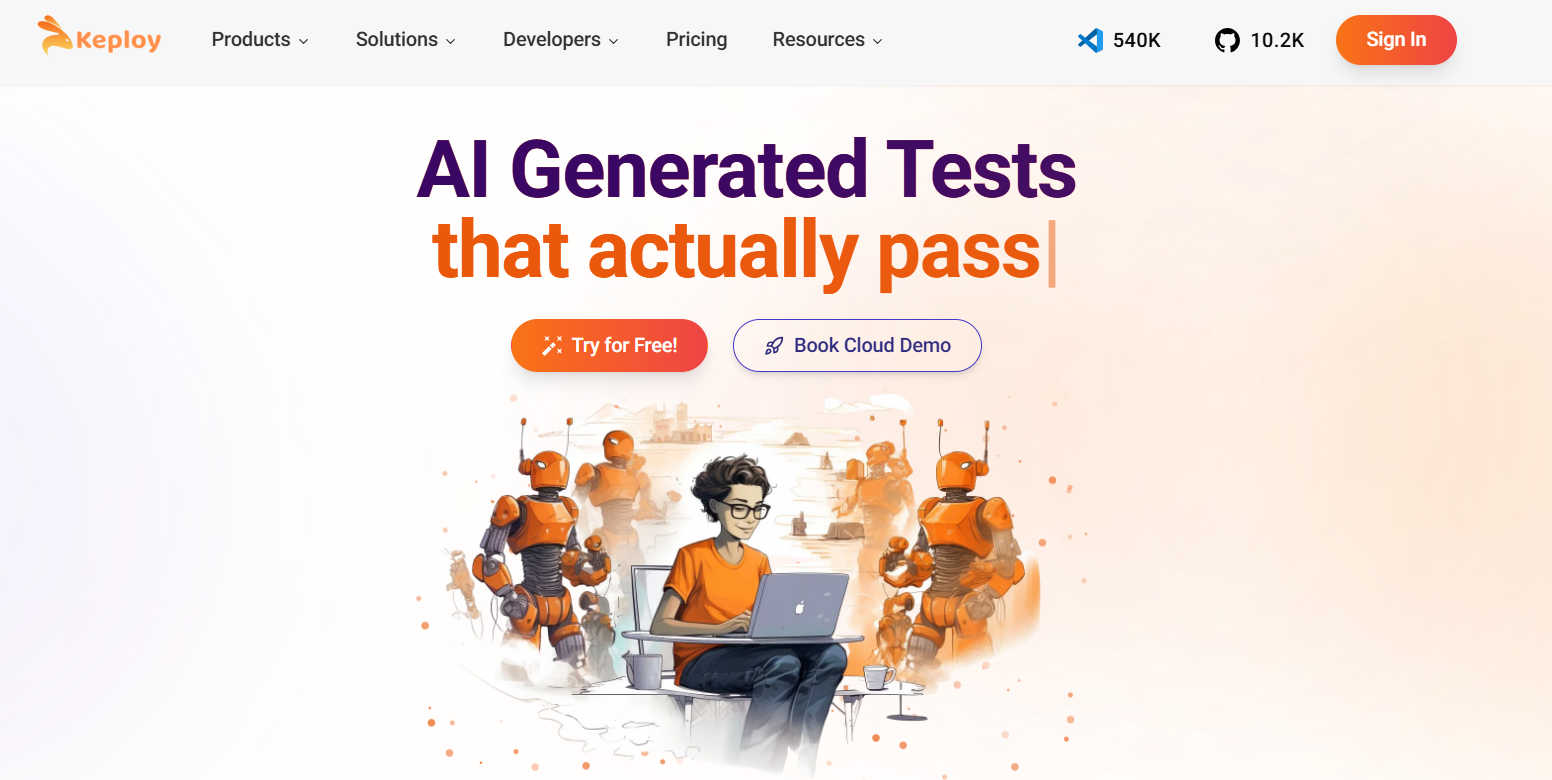
Keploy automatically creates reliable API tests from real traffic to boost your coverage in minutes.
Last updated: March 1, 2026

qtrl.ai
qtrl.ai scales QA testing with AI agents while ensuring full team control and governance.
Last updated: March 4, 2026
Visual Comparison
Keploy
qtrl.ai
Feature Comparison
Keploy
AI-Powered Test & Mock Generation
Keploy's AI engine intelligently records all API calls, database queries, and external dependencies during application runtime. It then automatically transforms this traffic into executable test cases and corresponding mocks or stubs. This eliminates the need for developers to manually write complex test logic or mock definitions, ensuring tests are based on real-world usage patterns and are inherently stable and deterministic.
Record and Replay in Isolated Sandbox
The platform allows you to record API traffic directly from your live application or local environment. These recorded sessions can then be replayed in a completely isolated sandbox within your CI/CD pipeline. This isolation ensures tests are consistent, fast, and free from flakiness caused by external dependencies or shared state, providing reliable results every time the pipeline runs.
Comprehensive Coverage Reporting
Keploy provides detailed, actionable insights into your test coverage. It goes beyond simple line coverage to show which APIs, code paths, and integrations are tested. This visibility helps teams identify critical gaps in their test suites, prioritize testing efforts, and confidently measure progress toward quality goals, ensuring no regression slips through.
Performance Testing Integration
Beyond functional correctness, Keploy can leverage the recorded traffic patterns to generate performance and load tests. By simulating real-user behavior at scale, teams can identify performance bottlenecks, latency issues, and system limits early in the development cycle, enabling proactive optimization of application performance and reliability.
qtrl.ai
Enterprise-Grade Test Management
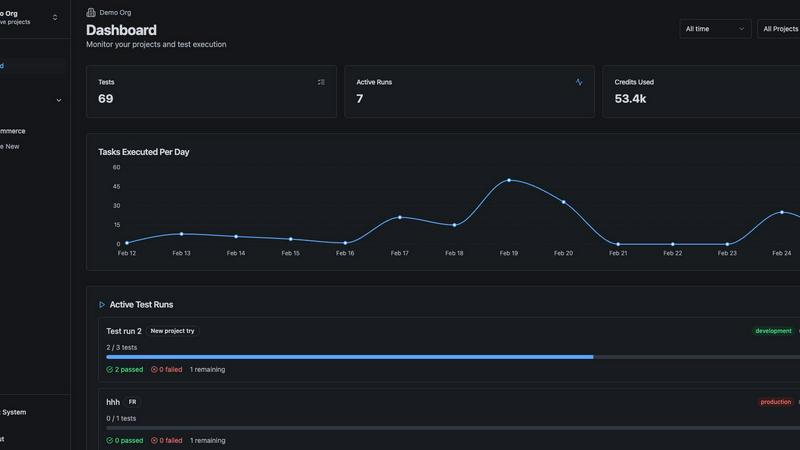
qtrl provides a centralized, structured foundation for all QA activities. Teams can create and organize test cases, plan comprehensive test runs, and establish full traceability from requirements to test coverage. Real-time dashboards offer clear visibility into quality metrics, showing exactly what has been tested, pass/fail statuses, and potential risk areas. This manual and automated workflow management is built with compliance and auditability as first principles, ensuring teams never lose oversight.
Progressive AI & Autonomous QA Agents
Instead of a risky "black-box" AI takeover, qtrl introduces intelligent automation progressively. Teams begin by writing high-level test instructions in plain English, which qtrl's agents execute precisely. As trust builds, teams can leverage AI to generate full test scripts from descriptions and maintain them as the application evolves. These autonomous agents operate within defined rules, executing tests on-demand or continuously across multiple environments at scale, using real browsers—not simulations.
Adaptive Memory & Intelligent Suggestions
The platform builds a living, evolving knowledge base of your application through every interaction—exploration, test execution, and issue discovery. This Adaptive Memory powers context-aware test generation that becomes more effective over time. Furthermore, qtrl proactively analyzes coverage gaps and suggests new tests to fill them, transforming the QA process from reactive maintenance to intelligent, continuous quality improvement.
Governance by Design & Multi-Environment Execution
qtrl is built for enterprise trust, with transparency and control embedded in its architecture. It offers permissioned autonomy levels, full visibility into agent actions, and enterprise-ready security. For execution, it supports running tests across any environment (dev, staging, production) with per-environment variables and encrypted secrets. Critically, these secrets are never exposed to the AI agent, ensuring security is never compromised for the sake of automation.
Use Cases
Keploy
Accelerating Legacy Code Testing
For teams maintaining large, untested legacy codebases, writing a comprehensive test suite from scratch is daunting. Keploy can be attached to the running application to automatically generate a foundational test suite from real traffic, dramatically reducing the initial effort and risk associated with modernizing and refactoring legacy systems.
Ensuring Reliability in Microservices
In a microservices architecture, testing service integrations is complex and time-consuming. Keploy excels at recording inter-service communications and generating integration tests with accurate mocks for each dependency. This ensures that each service can be tested in isolation while faithfully simulating its interactions with others.
Streamlining CI/CD Pipeline Testing
Development teams can integrate Keploy into their CI/CD pipelines to automatically generate and run tests with every build. This creates a fast, automated feedback loop where any regression introduced by new code is caught immediately, significantly improving deployment confidence and speeding up release cycles.
Enhancing Developer Productivity
Developers can use Keploy during feature development to automatically create tests for new APIs as they are being built and tested manually. This shifts testing left seamlessly, embedding quality assurance into the development workflow itself and freeing developers from the tedious task of manual test creation.
qtrl.ai
Scaling Beyond Manual Testing
QA teams overwhelmed by repetitive manual test cycles can use qtrl to systematically scale their efforts. They start by structuring their existing manual cases in the test management hub for better visibility. Then, they progressively automate the most tedious, high-value UI workflows using plain English instructions, freeing up human testers for more complex exploratory work and significantly accelerating release cycles without a steep learning curve.
Modernizing Legacy QA Workflows
Companies relying on outdated, siloed, or script-heavy automation frameworks can modernize without a disruptive rip-and-replace project. qtrl integrates with existing tools and CI/CD pipelines, allowing teams to bring their current processes into a centralized platform. They can then incrementally augment or replace brittle scripts with AI-generated tests that are easier to create and maintain, building a more resilient and efficient QA ecosystem over time.
Governing Enterprise AI Testing
For large organizations in regulated industries that require strict compliance, audit trails, and governance, qtrl provides a safe path to AI adoption. Its permissioned autonomy, full audit logs of all agent activities, and "no black-box" policy ensure that AI augments the QA process without introducing unpredictable risk. Engineering leads can grant automation capabilities while retaining ultimate approval and control over what tests run and what changes are made.
Empowering Product-Led Engineering Teams
Product-focused engineering teams that need to move fast but maintain high quality can embed qtrl into their development lifecycle. Developers can write high-level test instructions for new features, and qtrl handles the execution, providing immediate feedback. The platform's coverage analysis and test suggestions help ensure no regression is introduced, enabling faster, more confident deployments aligned with a product-led growth strategy.
Overview
About Keploy
Keploy is an innovative, AI-powered testing platform designed to solve one of the most persistent challenges in modern software development: achieving comprehensive test coverage without the immense manual effort and time investment. It is built for developers and engineering teams who are tired of the traditional, slow, and brittle process of writing and maintaining unit, integration, and API tests. Keploy's core value proposition is its ability to automatically generate stable, high-coverage test cases and mocks by simply recording real user traffic and API calls from your running application. This means developers can shift from manually authoring tests to automatically capturing them from actual behavior, achieving up to 90% coverage in minutes, not weeks. By supporting popular languages like Go, Java, Node.js, and Python, Keploy integrates seamlessly into diverse tech stacks, allowing teams to focus on building features and improving code quality rather than getting bogged down in testing logistics. It transforms testing from a bottleneck into a seamless, automated part of the development lifecycle.
About qtrl.ai
qtrl.ai is a modern, progressive QA platform designed to solve the critical scaling challenges faced by software teams today. It bridges the frustrating gap between the slow, unscalable nature of manual testing and the brittle, expensive complexity of traditional test automation. qtrl uniquely combines robust, enterprise-grade test management with powerful, trustworthy AI automation, all within a single, governed platform. Its core value proposition is enabling teams to scale their quality assurance efforts without ever sacrificing control, visibility, or governance. Teams start with a centralized hub for organizing test cases, planning runs, tracing requirements, and tracking real-time quality metrics. From this foundation of clarity and control, they can progressively introduce intelligent automation. qtrl's autonomous agents can generate and maintain UI tests from plain English, executing them at scale across real browsers and environments. This makes it the ideal solution for product-led engineering teams, QA groups moving beyond manual processes, companies modernizing legacy workflows, and any enterprise that requires strict compliance, full audit trails, and a trusted path to faster, more intelligent quality assurance.
Frequently Asked Questions
Keploy FAQ
How does Keploy generate tests without writing code?
Keploy works by recording the network interactions (HTTP API calls, database queries, etc.) of your running application. Its AI engine analyzes this traffic to understand the application's behavior, request/response structures, and dependencies. It then automatically synthesizes this data into executable test cases and creates intelligent mocks for external services, all without requiring manual test script writing.
What programming languages does Keploy support?
Keploy offers broad language support to fit into diverse development environments. It currently provides dedicated support for Go, Java, Node.js (JavaScript/TypeScript), and Python. This allows development teams across different tech stacks to leverage its automated testing capabilities.
Is Keploy an open-source tool?
Yes, Keploy has a strong open-source foundation. The core Keploy engine is available as open-source software, which has garnered significant community adoption with over 15.6k stars on GitHub. The company also offers commercial cloud and enterprise solutions with additional features, support, and scalability for teams.
Can Keploy tests replace all my manually written tests?
Keploy is designed to automate the creation of the majority of your integration and API test suites, potentially covering up to 90% of your testing needs. It excels at generating tests for existing behavior and new features as you build them. However, unit tests for complex business logic or very specific edge cases might still benefit from manual authoring. Keploy aims to handle the bulk, freeing you to focus on the most critical and complex testing scenarios.
qtrl.ai FAQ
How does qtrl.ai ensure control and governance over AI actions?
qtrl is built with governance as a core design principle. It does not operate as a black box. Teams set permission levels for autonomy, and all AI-generated tests or actions are fully reviewable and require human approval before implementation. The platform provides complete visibility into every action an autonomous agent takes, maintains full audit trails for compliance, and allows teams to define the exact rules and boundaries within which the AI operates.
Can qtrl.ai integrate with our existing development tools and CI/CD pipeline?
Yes, qtrl is designed to fit into real-world engineering workflows. It offers integrations for requirements management and seamless support for CI/CD pipelines. This allows teams to trigger automated test suites as part of their build and deployment processes, enabling continuous quality feedback loops. qtrl works alongside your existing toolchain to enhance it, not replace it forcibly.
Is my application data secure, especially when using AI agents?
Absolutely. qtrl employs enterprise-grade security measures. A key feature is the secure handling of sensitive data: per-environment variables and encrypted secrets (like login credentials) are managed securely and are never exposed to the AI agents. The agents execute tests without accessing the underlying secret values, ensuring that your most sensitive data remains protected while still enabling automated testing.
What if we are not ready for full AI automation? Can we still use qtrl?
Yes, this is a fundamental strength of qtrl's progressive approach. You can start using it solely as a powerful, structured test management platform to organize manual test cases and plans. You can then introduce automation at your own pace, beginning with simple, human-written instructions for the agent to execute. The AI capabilities are there to leverage when you are ready, allowing you to start simple and scale intelligence over time.
Alternatives
Keploy Alternatives
Keploy is an AI-powered testing tool that automates the creation of test cases and mocks, aiming to maximize coverage with minimal manual effort. It falls into the category of AI-driven development and testing assistants, helping teams improve software quality. Users often explore alternatives to Keploy for various reasons. These can include budget constraints, specific feature requirements not fully met, compatibility with niche tech stacks, or a preference for different integration or reporting workflows. Every team's testing maturity and operational needs are unique. When evaluating an alternative, consider key factors like the depth of AI-driven test generation, ease of integration with your existing tools, the robustness of API mocking capabilities, and the clarity of reporting. The right solution should align with your team's primary challenge, whether it's reducing flaky tests, accelerating test creation, or gaining better insights into coverage.
qtrl.ai Alternatives
qtrl.ai is a modern QA platform in the automation and dev tools category. It helps software teams scale testing by combining structured test management with trustworthy AI agents, offering a controlled path to intelligent automation. Users often explore alternatives for various reasons. These can include budget constraints, the need for a different feature set, or specific platform requirements like deeper integration with an existing toolchain. The search for the right fit is a normal part of the software selection process. When evaluating options, consider your team's primary goals. Look for a solution that balances powerful automation with the governance and control your processes demand. The ideal platform should grow with you, providing a clear path from manual testing to scalable, AI-assisted quality assurance without becoming a black box.