Playwriter vs qtrl.ai
Side-by-side comparison to help you choose the right tool.

Playwriter
Playwriter lets AI agents control your real Chrome browser with all your logins and extensions intact.
Last updated: March 18, 2026

qtrl.ai
qtrl.ai scales QA testing with AI agents while ensuring full team control and governance.
Last updated: March 4, 2026
Visual Comparison
Playwriter

qtrl.ai
Feature Comparison
Playwriter
Your Actual Browser Session
Playwriter's cornerstone feature is its ability to let AI agents control your real, logged-in Chrome browser. Instead of launching a fresh, suspicious-looking headless instance, the agent operates directly in your existing window. All your cookies, active sessions on sites like Gmail or GitHub, and essential extensions (like password managers or ad blockers) are present and functional. This eliminates bot detection triggers that stem from "clean" browser fingerprints and removes the massive overhead of manually scripting login sequences for every automated task.
Full Playwright API via a Single Tool
Unlike other solutions that expose a limited, pre-defined set of tools (like "click" or "type"), Playwriter grants agents the full power of the Playwright automation library through one versatile execute command. The agent can write and run any Playwright code, enabling complex operations like performance profiling, setting JavaScript breakpoints, intercepting and modifying network requests, or taking efficient accessibility snapshots. This "one tool to rule them all" approach avoids the context window bloat of dozens of individual tool definitions and provides maximum flexibility.
Real-Time Human-in-the-Loop Collaboration
This feature transforms automation from a fire-and-forget script into an interactive partnership. You watch the agent perform actions live in your browser tab. If it encounters a captcha, a two-factor authentication prompt, or a quirky website dialog, you can simply solve it yourself. If the agent gets lost, you can temporarily disable control on that tab, manually navigate to the correct state, and re-enable the agent to continue. This collaborative debug loop makes complex, real-world automation feasible and reliable.
Advanced Debugging & Inspection Suite
Playwriter is built for development, not just execution. It includes a powerful suite of debugging tools: live code editing, breakpoints to pause execution, network request interception to mock APIs or analyze traffic, and built-in screen recording. Crucially, it uses compact accessibility snapshots (5-20KB) instead of bulky full-page screenshots, providing AI agents with a lightweight, semantic understanding of the page structure for reliable element selection and action planning.
qtrl.ai
Enterprise-Grade Test Management
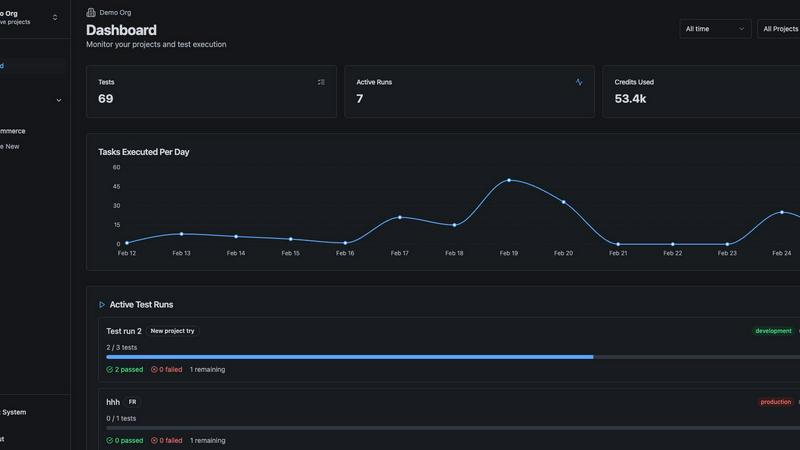
qtrl provides a centralized, structured foundation for all QA activities. Teams can create and organize test cases, plan comprehensive test runs, and establish full traceability from requirements to test coverage. Real-time dashboards offer clear visibility into quality metrics, showing exactly what has been tested, pass/fail statuses, and potential risk areas. This manual and automated workflow management is built with compliance and auditability as first principles, ensuring teams never lose oversight.
Progressive AI & Autonomous QA Agents
Instead of a risky "black-box" AI takeover, qtrl introduces intelligent automation progressively. Teams begin by writing high-level test instructions in plain English, which qtrl's agents execute precisely. As trust builds, teams can leverage AI to generate full test scripts from descriptions and maintain them as the application evolves. These autonomous agents operate within defined rules, executing tests on-demand or continuously across multiple environments at scale, using real browsers—not simulations.
Adaptive Memory & Intelligent Suggestions
The platform builds a living, evolving knowledge base of your application through every interaction—exploration, test execution, and issue discovery. This Adaptive Memory powers context-aware test generation that becomes more effective over time. Furthermore, qtrl proactively analyzes coverage gaps and suggests new tests to fill them, transforming the QA process from reactive maintenance to intelligent, continuous quality improvement.
Governance by Design & Multi-Environment Execution
qtrl is built for enterprise trust, with transparency and control embedded in its architecture. It offers permissioned autonomy levels, full visibility into agent actions, and enterprise-ready security. For execution, it supports running tests across any environment (dev, staging, production) with per-environment variables and encrypted secrets. Critically, these secrets are never exposed to the AI agent, ensuring security is never compromised for the sake of automation.
Use Cases
Playwriter
Automated Data Aggregation & Research
For professionals who need to compile reports from multiple web sources, Playwriter is ideal. An AI agent can be instructed to log into your premium news portal, search for specific terms, navigate through paginated results, extract key information, and format it into a document—all while maintaining your subscription login state and bypassing paywalls that would block a fresh browser session.
Streamlined QA and Testing Workflows
Developers and QA engineers can use Playwriter to create and run complex, stateful test scenarios directly in a production-like browser environment. The agent can test multi-step user journeys that depend on being logged in, such as adding items to a cart, applying user-specific coupons, and proceeding to checkout, with the human tester observing and intervening only for non-automatable steps.
AI-Assisted Daily Administrative Tasks
Automate repetitive daily web tasks without security compromises. Instruct your AI to log into your company's HR portal and submit a timesheet, check specific metrics on a logged-in analytics dashboard, or moderate comments on a CMS where you are already authenticated. Since it uses your session, there's no need to share sensitive credentials with a third-party automation service.
Interactive Web Scraping and Monitoring
For projects that require scraping data from websites with complex authentication or anti-bot measures, Playwriter provides a robust solution. The AI can navigate these sites using your legitimate session, handle JavaScript-rendered content with ease using Playwright's full API, and set up monitoring scripts that alert you when specific page content changes, all while you maintain oversight.
qtrl.ai
Scaling Beyond Manual Testing
QA teams overwhelmed by repetitive manual test cycles can use qtrl to systematically scale their efforts. They start by structuring their existing manual cases in the test management hub for better visibility. Then, they progressively automate the most tedious, high-value UI workflows using plain English instructions, freeing up human testers for more complex exploratory work and significantly accelerating release cycles without a steep learning curve.
Modernizing Legacy QA Workflows
Companies relying on outdated, siloed, or script-heavy automation frameworks can modernize without a disruptive rip-and-replace project. qtrl integrates with existing tools and CI/CD pipelines, allowing teams to bring their current processes into a centralized platform. They can then incrementally augment or replace brittle scripts with AI-generated tests that are easier to create and maintain, building a more resilient and efficient QA ecosystem over time.
Governing Enterprise AI Testing
For large organizations in regulated industries that require strict compliance, audit trails, and governance, qtrl provides a safe path to AI adoption. Its permissioned autonomy, full audit logs of all agent activities, and "no black-box" policy ensure that AI augments the QA process without introducing unpredictable risk. Engineering leads can grant automation capabilities while retaining ultimate approval and control over what tests run and what changes are made.
Empowering Product-Led Engineering Teams
Product-focused engineering teams that need to move fast but maintain high quality can embed qtrl into their development lifecycle. Developers can write high-level test instructions for new features, and qtrl handles the execution, providing immediate feedback. The platform's coverage analysis and test suggestions help ensure no regression is introduced, enabling faster, more confident deployments aligned with a product-led growth strategy.
Overview
About Playwriter
Playwriter is a revolutionary open-source tool that solves the fundamental problem of web browsing for AI agents. Traditional methods force agents to work in isolated, "clean" browser environments devoid of personal data, leading to instant bot detection, broken workflows, and repetitive manual logins. Playwriter flips this model entirely. It gives AI agents direct, programmable access to your actual Chrome browser session through a simple extension and CLI. This means your agents can operate in a browser that already has all your cookies, active logins, installed extensions, and user-specific settings. The core value proposition is seamless human-AI collaboration: the AI handles the tedious, repetitive automation tasks, while you remain in control, able to oversee actions in real-time and intervene instantly for captchas, consent dialogs, or unexpected issues. Built on the robust Playwright API and adhering to the Model Context Protocol (MCP), it integrates with popular clients like Cursor, Claude Desktop, and VS Code, offering a powerful, low-context automation platform that works within your existing digital environment without spawning extra processes or consuming significant additional memory.
About qtrl.ai
qtrl.ai is a modern, progressive QA platform designed to solve the critical scaling challenges faced by software teams today. It bridges the frustrating gap between the slow, unscalable nature of manual testing and the brittle, expensive complexity of traditional test automation. qtrl uniquely combines robust, enterprise-grade test management with powerful, trustworthy AI automation, all within a single, governed platform. Its core value proposition is enabling teams to scale their quality assurance efforts without ever sacrificing control, visibility, or governance. Teams start with a centralized hub for organizing test cases, planning runs, tracing requirements, and tracking real-time quality metrics. From this foundation of clarity and control, they can progressively introduce intelligent automation. qtrl's autonomous agents can generate and maintain UI tests from plain English, executing them at scale across real browsers and environments. This makes it the ideal solution for product-led engineering teams, QA groups moving beyond manual processes, companies modernizing legacy workflows, and any enterprise that requires strict compliance, full audit trails, and a trusted path to faster, more intelligent quality assurance.
Frequently Asked Questions
Playwriter FAQ
How does Playwriter handle security and privacy?
Playwriter is designed with a local-first architecture. The Chrome extension connects only to a WebSocket relay running on your own machine (localhost). No browser data, cookies, or session information is sent to any remote server. All automation commands and responses stay on your computer. You have complete visibility and control, as you watch every action the AI performs in real time in your browser window.
Can I use Playwriter with multiple browser tabs or agents?
Yes, the local relay multiplexes sessions. You can attach the Playwriter extension to multiple tabs in your browser (each tab turns green when attached). Multiple AI agents or CLI instances can then control different tabs simultaneously, or collaborate on the same tab, enabling complex multi-agent workflows or parallel task execution.
What happens if the AI gets stuck or makes a mistake?
This is where the human-in-the-loop model shines. You are watching the browser. If the agent clicks the wrong element or gets stuck in a loop, you can immediately click the extension icon to detach control (turning it gray), manually fix the issue, and then re-attach the agent. The agent continues from the new browser state, making debugging and recovery incredibly fast.
Is Playwriter free to use?
Yes. Playwriter is completely open-source software released under the permissive MIT license. You can download, use, modify, and distribute it for free, both personally and commercially. There are no subscription fees, tiered plans, or usage limits. The project is supported by its community and contributions on GitHub.
qtrl.ai FAQ
How does qtrl.ai ensure control and governance over AI actions?
qtrl is built with governance as a core design principle. It does not operate as a black box. Teams set permission levels for autonomy, and all AI-generated tests or actions are fully reviewable and require human approval before implementation. The platform provides complete visibility into every action an autonomous agent takes, maintains full audit trails for compliance, and allows teams to define the exact rules and boundaries within which the AI operates.
Can qtrl.ai integrate with our existing development tools and CI/CD pipeline?
Yes, qtrl is designed to fit into real-world engineering workflows. It offers integrations for requirements management and seamless support for CI/CD pipelines. This allows teams to trigger automated test suites as part of their build and deployment processes, enabling continuous quality feedback loops. qtrl works alongside your existing toolchain to enhance it, not replace it forcibly.
Is my application data secure, especially when using AI agents?
Absolutely. qtrl employs enterprise-grade security measures. A key feature is the secure handling of sensitive data: per-environment variables and encrypted secrets (like login credentials) are managed securely and are never exposed to the AI agents. The agents execute tests without accessing the underlying secret values, ensuring that your most sensitive data remains protected while still enabling automated testing.
What if we are not ready for full AI automation? Can we still use qtrl?
Yes, this is a fundamental strength of qtrl's progressive approach. You can start using it solely as a powerful, structured test management platform to organize manual test cases and plans. You can then introduce automation at your own pace, beginning with simple, human-written instructions for the agent to execute. The AI capabilities are there to leverage when you are ready, allowing you to start simple and scale intelligence over time.
Alternatives
Playwriter Alternatives
Playwriter is an open-source automation tool that gives AI agents direct, authenticated control of your Chrome browser. It solves the core problem of agents working in isolated, "fresh" browser sessions that lack logins, extensions, and context, making real web interaction impossible. This places it in the browser automation and AI agent tooling category. Users explore alternatives for various reasons. Some may need features tailored to different platforms or browsers, require a specific pricing model like a managed cloud service, or seek a different technical approach, such as a standalone application versus a Chrome extension. Others might prioritize different aspects of the developer experience or integration capabilities. When evaluating options, consider the core value: does the tool provide authenticated, stateful browser access to AI? Key factors include whether it works with your existing logged-in sessions and extensions, its approach to providing browser context to the AI (like lightweight snapshots versus heavy screenshots), the depth of its debugging and control features, and its compatibility with your preferred AI client or framework via standards like MCP.
qtrl.ai Alternatives
qtrl.ai is a modern QA platform in the automation and dev tools category. It helps software teams scale testing by combining structured test management with trustworthy AI agents, offering a controlled path to intelligent automation. Users often explore alternatives for various reasons. These can include budget constraints, the need for a different feature set, or specific platform requirements like deeper integration with an existing toolchain. The search for the right fit is a normal part of the software selection process. When evaluating options, consider your team's primary goals. Look for a solution that balances powerful automation with the governance and control your processes demand. The ideal platform should grow with you, providing a clear path from manual testing to scalable, AI-assisted quality assurance without becoming a black box.