qtrl.ai vs Stable Commerce
Side-by-side comparison to help you choose the right tool.

qtrl.ai
qtrl.ai scales QA testing with AI agents while ensuring full team control and governance.
Last updated: March 4, 2026

Stable Commerce
Launch a fully optimized online store in under two minutes with our AI agent.
Last updated: March 4, 2026
Visual Comparison
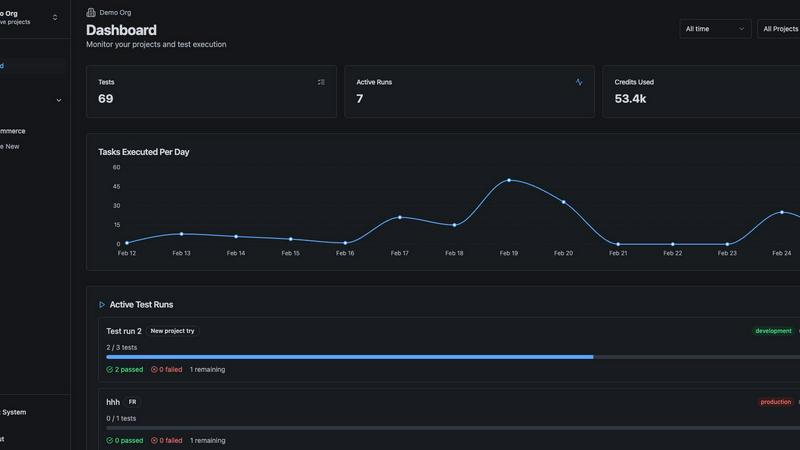
qtrl.ai
Stable Commerce
Feature Comparison
qtrl.ai
Enterprise-Grade Test Management
qtrl provides a centralized, structured foundation for all QA activities. Teams can create and organize test cases, plan comprehensive test runs, and establish full traceability from requirements to test coverage. Real-time dashboards offer clear visibility into quality metrics, showing exactly what has been tested, pass/fail statuses, and potential risk areas. This manual and automated workflow management is built with compliance and auditability as first principles, ensuring teams never lose oversight.
Progressive AI & Autonomous QA Agents
Instead of a risky "black-box" AI takeover, qtrl introduces intelligent automation progressively. Teams begin by writing high-level test instructions in plain English, which qtrl's agents execute precisely. As trust builds, teams can leverage AI to generate full test scripts from descriptions and maintain them as the application evolves. These autonomous agents operate within defined rules, executing tests on-demand or continuously across multiple environments at scale, using real browsers—not simulations.
Adaptive Memory & Intelligent Suggestions
The platform builds a living, evolving knowledge base of your application through every interaction—exploration, test execution, and issue discovery. This Adaptive Memory powers context-aware test generation that becomes more effective over time. Furthermore, qtrl proactively analyzes coverage gaps and suggests new tests to fill them, transforming the QA process from reactive maintenance to intelligent, continuous quality improvement.
Governance by Design & Multi-Environment Execution
qtrl is built for enterprise trust, with transparency and control embedded in its architecture. It offers permissioned autonomy levels, full visibility into agent actions, and enterprise-ready security. For execution, it supports running tests across any environment (dev, staging, production) with per-environment variables and encrypted secrets. Critically, these secrets are never exposed to the AI agent, ensuring security is never compromised for the sake of automation.
Stable Commerce
Prompt-to-Store Generator
This core feature allows you to launch a complete, live online store in under two minutes simply by describing what you want to sell. You provide a simple text prompt, and the AI agent takes over, automatically generating the storefront, applying a design, setting up the necessary pages, and integrating foundational systems. It eliminates weeks of setup work, making the initial launch process effortless and immediate, so you can go from idea to revenue faster than ever before.
Autonomous Commerce Agent
Acting as your tireless digital operations manager, this AI agent orchestrates the entire e-commerce stack after the initial setup. It continuously manages and connects storefronts, marketplaces, customer systems, analytics, and fulfillment logistics in the background. It analyzes real-time data, optimizes for better performance, and ensures all workflows run smoothly without manual intervention, effectively replacing the need for a large, costly operations team.
Integrated Complete E-commerce Stack
Stable Commerce provides a unified, all-in-one platform that includes every critical component for running a business. This encompasses inventory management across unlimited locations, order processing, integrated payment gateways like Stripe and PayPal, fulfillment APIs, customer service tools, and enterprise-grade security with SSL and fraud protection. There is no need to juggle disparate plugins or third-party services, ensuring a seamless and secure operation.
Live Analytics & Continuous Optimization
The platform offers managed analytics that track sales, customer behavior, and operational metrics in real time, presented without complex spreadsheets. More importantly, the system uses this live data to autonomously optimize your store. It constantly tweaks and tinkers with various elements to improve conversion rates, enhance efficiency, and boost overall performance, ensuring your store is always running at its peak potential automatically.
Use Cases
qtrl.ai
Scaling Beyond Manual Testing
QA teams overwhelmed by repetitive manual test cycles can use qtrl to systematically scale their efforts. They start by structuring their existing manual cases in the test management hub for better visibility. Then, they progressively automate the most tedious, high-value UI workflows using plain English instructions, freeing up human testers for more complex exploratory work and significantly accelerating release cycles without a steep learning curve.
Modernizing Legacy QA Workflows
Companies relying on outdated, siloed, or script-heavy automation frameworks can modernize without a disruptive rip-and-replace project. qtrl integrates with existing tools and CI/CD pipelines, allowing teams to bring their current processes into a centralized platform. They can then incrementally augment or replace brittle scripts with AI-generated tests that are easier to create and maintain, building a more resilient and efficient QA ecosystem over time.
Governing Enterprise AI Testing
For large organizations in regulated industries that require strict compliance, audit trails, and governance, qtrl provides a safe path to AI adoption. Its permissioned autonomy, full audit logs of all agent activities, and "no black-box" policy ensure that AI augments the QA process without introducing unpredictable risk. Engineering leads can grant automation capabilities while retaining ultimate approval and control over what tests run and what changes are made.
Empowering Product-Led Engineering Teams
Product-focused engineering teams that need to move fast but maintain high quality can embed qtrl into their development lifecycle. Developers can write high-level test instructions for new features, and qtrl handles the execution, providing immediate feedback. The platform's coverage analysis and test suggestions help ensure no regression is introduced, enabling faster, more confident deployments aligned with a product-led growth strategy.
Stable Commerce
First-Time Entrepreneurs & Side Hustlers
Individuals with a product idea but zero technical or e-commerce experience can use Stable Commerce to bypass the intimidating learning curve. They can describe their vision in a prompt and have a professional, fully functional store ready to accept orders in minutes. This democratizes online retail, allowing anyone to test a business idea with minimal risk, time, and upfront investment.
Established Sellers Scaling Operations
Growing businesses drowning in the complexity of multiple plugins, apps, and developer fees can consolidate their entire operation onto Stable Commerce. The autonomous agent handles the orchestration and optimization of their expanding sales channels and logistics, freeing the owner from daily operational headaches and reducing six-figure annual team costs, allowing them to focus purely on strategic growth.
Agencies Managing Multiple Client Stores
Marketing or e-commerce agencies can leverage the platform to build, deploy, and manage stores for their clients with unprecedented speed and consistency. The prompt-based generation and unified stack allow for rapid prototyping and deployment, while the autonomous management features reduce the ongoing maintenance burden, enabling agencies to scale their service offerings profitably.
Brands Expanding to New Marketplaces
Businesses looking to expand their reach beyond their primary website can use Stable Commerce to seamlessly integrate and manage listings on additional marketplaces. The platform's agent can handle the synchronization of inventory, orders, and analytics across these new channels from a single dashboard, simplifying multi-channel sales without multiplying the operational workload.
Overview
About qtrl.ai
qtrl.ai is a modern, progressive QA platform designed to solve the critical scaling challenges faced by software teams today. It bridges the frustrating gap between the slow, unscalable nature of manual testing and the brittle, expensive complexity of traditional test automation. qtrl uniquely combines robust, enterprise-grade test management with powerful, trustworthy AI automation, all within a single, governed platform. Its core value proposition is enabling teams to scale their quality assurance efforts without ever sacrificing control, visibility, or governance. Teams start with a centralized hub for organizing test cases, planning runs, tracing requirements, and tracking real-time quality metrics. From this foundation of clarity and control, they can progressively introduce intelligent automation. qtrl's autonomous agents can generate and maintain UI tests from plain English, executing them at scale across real browsers and environments. This makes it the ideal solution for product-led engineering teams, QA groups moving beyond manual processes, companies modernizing legacy workflows, and any enterprise that requires strict compliance, full audit trails, and a trusted path to faster, more intelligent quality assurance.
About Stable Commerce
Stable Commerce is an AI-first e-commerce engine designed to dismantle the traditional, complex barriers of launching and running an online store. It addresses the core challenge faced by entrepreneurs and businesses: the overwhelming technical overhead, costly developer dependencies, and fragmented toolset management that stifles growth. This platform serves as an autonomous eComOps framework, transforming a simple idea into a fully operational, optimized online business with a single prompt. It is built for anyone from first-time sellers tired of plugin chaos to seasoned professionals seeking to eliminate operational bottlenecks and scale efficiently. The main value proposition is profound simplicity and automation. By leveraging a proprietary AI agent, Stable Commerce autonomously builds storefronts, connects payment and analytics systems, manages inventory, and continuously optimizes performance. This allows store owners to bypass the need for multiple apps, expensive developers, and entire operational teams, saving over $100K in annual costs while focusing entirely on strategy, products, and customer relationships.
Frequently Asked Questions
qtrl.ai FAQ
How does qtrl.ai ensure control and governance over AI actions?
qtrl is built with governance as a core design principle. It does not operate as a black box. Teams set permission levels for autonomy, and all AI-generated tests or actions are fully reviewable and require human approval before implementation. The platform provides complete visibility into every action an autonomous agent takes, maintains full audit trails for compliance, and allows teams to define the exact rules and boundaries within which the AI operates.
Can qtrl.ai integrate with our existing development tools and CI/CD pipeline?
Yes, qtrl is designed to fit into real-world engineering workflows. It offers integrations for requirements management and seamless support for CI/CD pipelines. This allows teams to trigger automated test suites as part of their build and deployment processes, enabling continuous quality feedback loops. qtrl works alongside your existing toolchain to enhance it, not replace it forcibly.
Is my application data secure, especially when using AI agents?
Absolutely. qtrl employs enterprise-grade security measures. A key feature is the secure handling of sensitive data: per-environment variables and encrypted secrets (like login credentials) are managed securely and are never exposed to the AI agents. The agents execute tests without accessing the underlying secret values, ensuring that your most sensitive data remains protected while still enabling automated testing.
What if we are not ready for full AI automation? Can we still use qtrl?
Yes, this is a fundamental strength of qtrl's progressive approach. You can start using it solely as a powerful, structured test management platform to organize manual test cases and plans. You can then introduce automation at your own pace, beginning with simple, human-written instructions for the agent to execute. The AI capabilities are there to leverage when you are ready, allowing you to start simple and scale intelligence over time.
Stable Commerce FAQ
How quickly can I really launch a store?
You can have a basic, fully functional store live and ready to accept orders in under two minutes. The process starts with you providing a simple text prompt describing what you want to sell. Our AI agent then automatically generates the storefront, applies a design template, sets up essential pages, and integrates core systems like a shopping cart and basic payments.
What does the "Autonomous Agent" actually do?
Think of it as your AI-powered operations manager. Once your store is created, the agent takes over the ongoing heavy lifting. It connects and manages all your tools (like analytics and fulfillment services), monitors performance in real-time, optimizes your store for better sales, and ensures all backend processes run smoothly 24/7 without you needing to manually configure plugins or oversee daily tasks.
Can I import my existing products?
Yes, absolutely. Stable Commerce allows you to easily import your product catalog from various sources. You can upload product data via Excel or CSV files. Furthermore, depending on your plan, you can directly import products from major marketplaces like eBay, Etsy, or Amazon, saving you the time of manually recreating your entire inventory.
Is there a free plan to try it out?
Yes, Stable Commerce offers a Free Forever plan perfect for testing the platform and running personal projects. It includes the core AI agent, allows 5 prompts per day, supports 1 store, and lets you import up to 5 products from marketplaces. It includes essential features like store customization, an SSL certificate, mobile-responsive design, and basic analytics.
Alternatives
qtrl.ai Alternatives
qtrl.ai is a modern QA platform in the automation and dev tools category. It helps software teams scale testing by combining structured test management with trustworthy AI agents, offering a controlled path to intelligent automation. Users often explore alternatives for various reasons. These can include budget constraints, the need for a different feature set, or specific platform requirements like deeper integration with an existing toolchain. The search for the right fit is a normal part of the software selection process. When evaluating options, consider your team's primary goals. Look for a solution that balances powerful automation with the governance and control your processes demand. The ideal platform should grow with you, providing a clear path from manual testing to scalable, AI-assisted quality assurance without becoming a black box.
Stable Commerce Alternatives
Stable Commerce is an AI-native eCommerce and automation platform designed to launch and manage online stores with minimal effort. Its core promise is to simplify the complex process of setting up and optimizing a digital storefront through intelligent automation. Users often explore alternatives for several key reasons. Pricing structures may not align with every budget, especially for those just starting out. Some businesses require very specific features or deeper customization that a general AI platform might not offer, while others might prioritize different aspects like advanced inventory management or native integrations with certain tools. When evaluating other platforms, focus on your primary business needs. Consider the total cost of ownership, including any transaction fees. Assess the level of control and customization available versus the simplicity of automation. Finally, examine the scalability of the platform to ensure it can grow alongside your business without requiring a disruptive migration later.