Playwriter vs ResponseHub
Side-by-side comparison to help you choose the right tool.

Playwriter
Playwriter lets AI agents control your real Chrome browser with all your logins and extensions intact.
Last updated: March 18, 2026

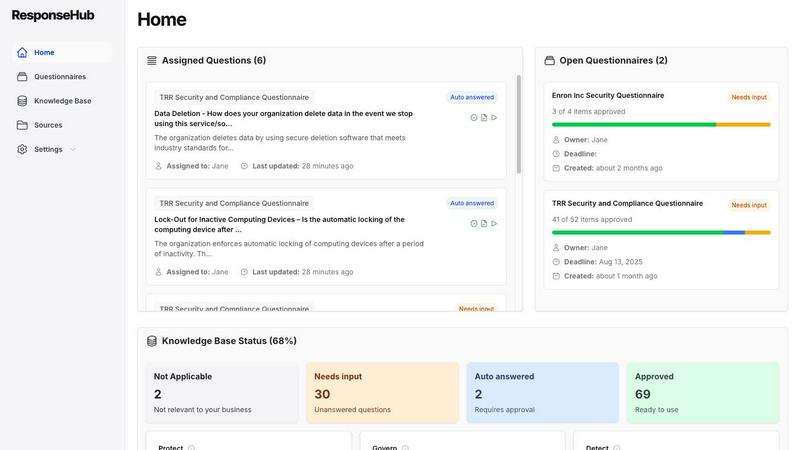
ResponseHub
ResponseHub automates security questionnaires, saving you time and ensuring accurate, referenced answers in hours.
Last updated: February 28, 2026
Visual Comparison
Playwriter

ResponseHub
Feature Comparison
Playwriter
Your Actual Browser Session
Playwriter's cornerstone feature is its ability to let AI agents control your real, logged-in Chrome browser. Instead of launching a fresh, suspicious-looking headless instance, the agent operates directly in your existing window. All your cookies, active sessions on sites like Gmail or GitHub, and essential extensions (like password managers or ad blockers) are present and functional. This eliminates bot detection triggers that stem from "clean" browser fingerprints and removes the massive overhead of manually scripting login sequences for every automated task.
Full Playwright API via a Single Tool
Unlike other solutions that expose a limited, pre-defined set of tools (like "click" or "type"), Playwriter grants agents the full power of the Playwright automation library through one versatile execute command. The agent can write and run any Playwright code, enabling complex operations like performance profiling, setting JavaScript breakpoints, intercepting and modifying network requests, or taking efficient accessibility snapshots. This "one tool to rule them all" approach avoids the context window bloat of dozens of individual tool definitions and provides maximum flexibility.
Real-Time Human-in-the-Loop Collaboration
This feature transforms automation from a fire-and-forget script into an interactive partnership. You watch the agent perform actions live in your browser tab. If it encounters a captcha, a two-factor authentication prompt, or a quirky website dialog, you can simply solve it yourself. If the agent gets lost, you can temporarily disable control on that tab, manually navigate to the correct state, and re-enable the agent to continue. This collaborative debug loop makes complex, real-world automation feasible and reliable.
Advanced Debugging & Inspection Suite
Playwriter is built for development, not just execution. It includes a powerful suite of debugging tools: live code editing, breakpoints to pause execution, network request interception to mock APIs or analyze traffic, and built-in screen recording. Crucially, it uses compact accessibility snapshots (5-20KB) instead of bulky full-page screenshots, providing AI agents with a lightweight, semantic understanding of the page structure for reliable element selection and action planning.
ResponseHub
Unlimited Source Documents
ResponseHub allows users to upload an unlimited number of policy documents, product descriptions, and standard operating procedures (SOPs). This flexibility ensures that all relevant context is available for accurate answers, removing any constraints on documentation needed for assessments.
Automated Knowledge Base
The platform features a dynamic knowledge base that remains up to date with AI-suggested additions from completed questionnaires. This ensures that teams have access to the latest information and best practices, streamlining the process of responding to future assessments.
AI-Powered Spreadsheet Parsing
ResponseHub's advanced AI can handle complex spreadsheets, regardless of their structure. It effectively identifies and extracts questions from multiple sheets and covers, making it easier for teams to manage even the most intricate security questionnaires without hassle.
Detailed Citations for Confidence
Every response generated by ResponseHub is meticulously referenced to the exact policy, section, page, and sentence from the source documents. This level of detail provides teams with complete confidence in their answers, ensuring compliance and accuracy during assessments.
Use Cases
Playwriter
Automated Data Aggregation & Research
For professionals who need to compile reports from multiple web sources, Playwriter is ideal. An AI agent can be instructed to log into your premium news portal, search for specific terms, navigate through paginated results, extract key information, and format it into a document—all while maintaining your subscription login state and bypassing paywalls that would block a fresh browser session.
Streamlined QA and Testing Workflows
Developers and QA engineers can use Playwriter to create and run complex, stateful test scenarios directly in a production-like browser environment. The agent can test multi-step user journeys that depend on being logged in, such as adding items to a cart, applying user-specific coupons, and proceeding to checkout, with the human tester observing and intervening only for non-automatable steps.
AI-Assisted Daily Administrative Tasks
Automate repetitive daily web tasks without security compromises. Instruct your AI to log into your company's HR portal and submit a timesheet, check specific metrics on a logged-in analytics dashboard, or moderate comments on a CMS where you are already authenticated. Since it uses your session, there's no need to share sensitive credentials with a third-party automation service.
Interactive Web Scraping and Monitoring
For projects that require scraping data from websites with complex authentication or anti-bot measures, Playwriter provides a robust solution. The AI can navigate these sites using your legitimate session, handle JavaScript-rendered content with ease using Playwright's full API, and set up monitoring scripts that alert you when specific page content changes, all while you maintain oversight.
ResponseHub
Accelerating Sales Processes
Sales teams can leverage ResponseHub to quickly complete security questionnaires, reducing the time spent on compliance tasks. This acceleration helps prevent delays in closing deals, thereby boosting revenue and maintaining competitive advantage.
Streamlining Onboarding
New teams or organizations can utilize ResponseHub to efficiently onboard by automating the completion of security assessments during the integration process. This allows new hires to focus on their core responsibilities rather than being bogged down by administrative tasks.
Enhancing Compliance Readiness
With ResponseHub, organizations can easily prepare for compliance audits by maintaining up-to-date documentation and responses. This proactive approach mitigates the risk of non-compliance and ensures that teams are ready for any assessments that may arise.
Delegating Responsibilities
ResponseHub enables organizations to assign specific questionnaire sections to subject matter experts. This delegation not only increases efficiency but also ensures that answers are accurate and backed by the right expertise, fostering collaboration within teams.
Overview
About Playwriter
Playwriter is a revolutionary open-source tool that solves the fundamental problem of web browsing for AI agents. Traditional methods force agents to work in isolated, "clean" browser environments devoid of personal data, leading to instant bot detection, broken workflows, and repetitive manual logins. Playwriter flips this model entirely. It gives AI agents direct, programmable access to your actual Chrome browser session through a simple extension and CLI. This means your agents can operate in a browser that already has all your cookies, active logins, installed extensions, and user-specific settings. The core value proposition is seamless human-AI collaboration: the AI handles the tedious, repetitive automation tasks, while you remain in control, able to oversee actions in real-time and intervene instantly for captchas, consent dialogs, or unexpected issues. Built on the robust Playwright API and adhering to the Model Context Protocol (MCP), it integrates with popular clients like Cursor, Claude Desktop, and VS Code, offering a powerful, low-context automation platform that works within your existing digital environment without spawning extra processes or consuming significant additional memory.
About ResponseHub
ResponseHub is an innovative AI-powered security questionnaire automation platform specifically designed to alleviate the burdens faced by technical and security teams during vendor security assessments. In today’s fast-paced business environment, startups and growing companies often grapple with the challenges of delayed revenue cycles, wasted engineering hours, and the critical risk of providing inaccurate compliance information. ResponseHub transforms the tedious task of completing complex security questionnaires—usually presented in convoluted Excel formats—into a streamlined process. By intelligently processing these documents and generating accurate, fully-cited responses, it empowers organizations to complete assessments in hours rather than days. With features like a continuously updating automated knowledge base and the ability to reference uploaded source documents, ResponseHub provides teams with the confidence to tackle compliance tasks efficiently. Founded by a former CTO who experienced the pain of manual assessments firsthand, ResponseHub not only saves time but also mitigates risks, allowing teams to focus on closing deals and enhancing their products.
Frequently Asked Questions
Playwriter FAQ
How does Playwriter handle security and privacy?
Playwriter is designed with a local-first architecture. The Chrome extension connects only to a WebSocket relay running on your own machine (localhost). No browser data, cookies, or session information is sent to any remote server. All automation commands and responses stay on your computer. You have complete visibility and control, as you watch every action the AI performs in real time in your browser window.
Can I use Playwriter with multiple browser tabs or agents?
Yes, the local relay multiplexes sessions. You can attach the Playwriter extension to multiple tabs in your browser (each tab turns green when attached). Multiple AI agents or CLI instances can then control different tabs simultaneously, or collaborate on the same tab, enabling complex multi-agent workflows or parallel task execution.
What happens if the AI gets stuck or makes a mistake?
This is where the human-in-the-loop model shines. You are watching the browser. If the agent clicks the wrong element or gets stuck in a loop, you can immediately click the extension icon to detach control (turning it gray), manually fix the issue, and then re-attach the agent. The agent continues from the new browser state, making debugging and recovery incredibly fast.
Is Playwriter free to use?
Yes. Playwriter is completely open-source software released under the permissive MIT license. You can download, use, modify, and distribute it for free, both personally and commercially. There are no subscription fees, tiered plans, or usage limits. The project is supported by its community and contributions on GitHub.
ResponseHub FAQ
How does ResponseHub ensure the accuracy of answers?
ResponseHub utilizes an automated knowledge base that references an organization’s uploaded source documents to generate precise responses. Each answer is fully cited, ensuring users can verify the information easily.
Can I upload any type of document to ResponseHub?
Yes, ResponseHub supports the uploading of a wide range of documents, including security policies, standard operating procedures, and product descriptions. There is no limit on the number of source documents you can upload.
Is there a learning curve associated with using ResponseHub?
ResponseHub is designed to be intuitive and user-friendly. With a self-serve trial available, users can get started in under five minutes. Additionally, AI-powered explainers for each question help guide users through the process.
What if I have existing questionnaires or policies?
ResponseHub allows users to import existing questionnaires and policies easily. If you have documents in formats like Google Sheets or Notion, you can export them to CSV and upload them to streamline your onboarding process.
Alternatives
Playwriter Alternatives
Playwriter is an open-source automation tool that gives AI agents direct, authenticated control of your Chrome browser. It solves the core problem of agents working in isolated, "fresh" browser sessions that lack logins, extensions, and context, making real web interaction impossible. This places it in the browser automation and AI agent tooling category. Users explore alternatives for various reasons. Some may need features tailored to different platforms or browsers, require a specific pricing model like a managed cloud service, or seek a different technical approach, such as a standalone application versus a Chrome extension. Others might prioritize different aspects of the developer experience or integration capabilities. When evaluating options, consider the core value: does the tool provide authenticated, stateful browser access to AI? Key factors include whether it works with your existing logged-in sessions and extensions, its approach to providing browser context to the AI (like lightweight snapshots versus heavy screenshots), the depth of its debugging and control features, and its compatibility with your preferred AI client or framework via standards like MCP.
ResponseHub Alternatives
ResponseHub is an AI-powered platform designed to automate the completion of security questionnaires, allowing technical and security teams to save significant time and resources. This innovative tool addresses common issues faced by startups and growing companies, such as delayed revenue cycles and the risk of providing inaccurate compliance information. As users explore alternatives to ResponseHub, they often seek different pricing structures, feature sets, or platform compatibility that better aligns with their specific needs and preferences. When considering an alternative to ResponseHub, it is essential to evaluate the capabilities of the platform, including its ease of use, the comprehensiveness of its knowledge base, and the accuracy of its automated responses. Additionally, potential users should assess the level of customer support provided, as well as the platform's ability to integrate with existing workflows. Prioritizing these factors will help ensure that the selected solution effectively meets the demands of security assessments and streamlines the vendor evaluation process.