Nabbed vs Skene
Side-by-side comparison to help you choose the right tool.

Track jobs & contacts. Get AI intel. Autofill ATS.

Skene turns your codebase into a growth engine you own and prompt.
Last updated: February 28, 2026
Visual Comparison
Nabbed
Skene
Overview
About Nabbed
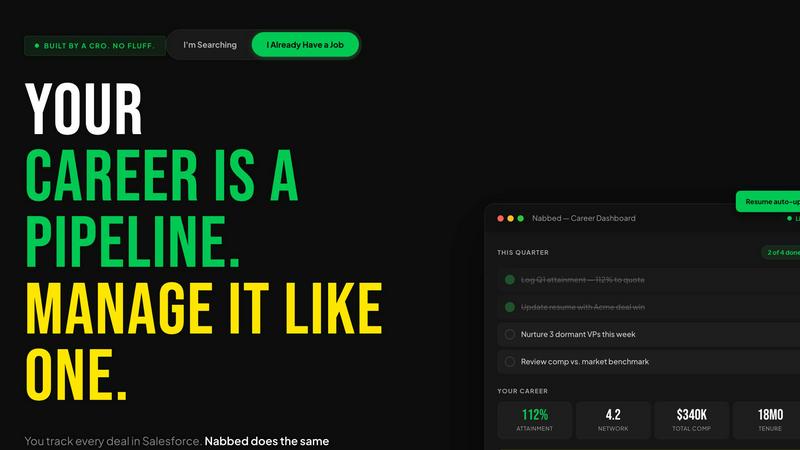
Nabbed is the first CRM built specifically for sales and revenue professionals managing their career. Track job applications in a visual pipeline, build a contact CRM with warm path mapping, get AI-powered company intelligence (funding, headcount, Glassdoor ratings), and autofill applications on 60+ ATS platforms with our Chrome extension. Features include Gmail auto-sync that detects interviews and rejections, hiring signal alerts when target companies are growing, interview prep with AI coaching, salary benchmarking with offer analysis, and a Job Fit Score that matches your profile to listings. Search 11 job sources at once including Google Jobs, Indeed, LinkedIn, and Glassdoor. Free tier available, Core at $19/mo.
About Skene
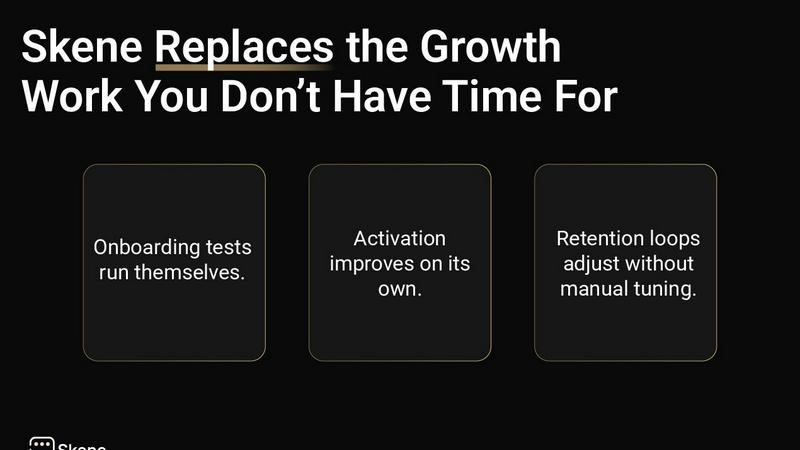
Skene is an AI-powered Product-Led Growth (PLG) infrastructure designed to automate growth for software products, specifically for indie developers, early-stage startups, and engineering teams. It tackles the core challenge of the immense time and resource drain required to manually build, test, and maintain user onboarding, activation, and retention flows. This work often falls on small teams who cannot afford dedicated growth engineers, forcing them to choose between building features and building growth mechanisms. Skene's solution is deeply technical and integrated: it connects directly to your codebase and IDE, analyzing your source code to automatically understand user flows and detect friction points. Instead of relying on external, brittle scripts and third-party widgets that break with updates and create data silos, Skene generates and runs growth experiments as code you own and version. This turns your product's growth layer into a programmable, self-optimizing part of your infrastructure. Its primary value proposition is allowing builders to ship and iterate on growth loops with the same tools, workflows, and sense of ownership they use to ship product features, effectively making growth a native component of the development process.