ScopeSnap vs Skene
Side-by-side comparison to help you choose the right tool.

ScopeSnap
ScopeSnap transforms messy discovery notes into clear, structured project scopes and polished proposals in minutes for freelance developers and.
Last updated: March 18, 2026

Skene turns your codebase into a growth engine you own and prompt.
Last updated: February 28, 2026
Visual Comparison
ScopeSnap
Skene
Feature Comparison
ScopeSnap
AI-Powered Backlog Generation
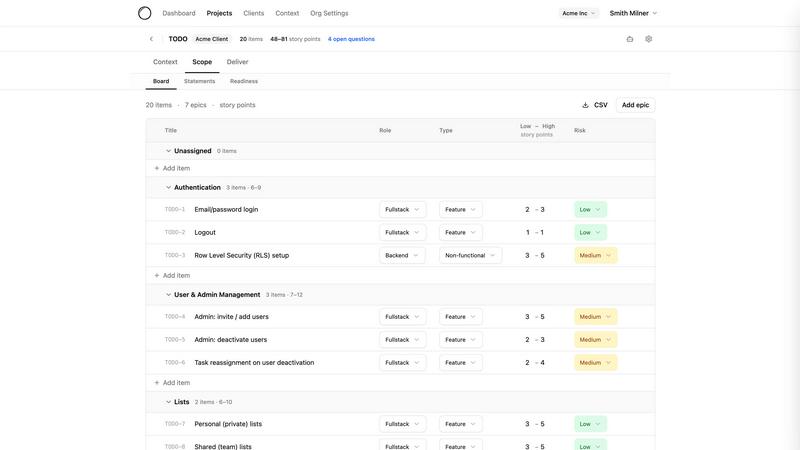
ScopeSnap utilizes advanced AI algorithms to convert your raw discovery notes into a structured backlog. This feature automatically generates epics and scope items, highlights open questions, and identifies assumptions, making it easier for developers to visualize their project requirements.
Iterative Refinement Process
The platform allows users to iteratively refine their project scope. As you review the generated backlog, you can assign roles, set estimates, and address any unresolved questions. This ensures that every element of the project is well understood and confidently estimated before moving forward.
Proposal and Statement of Work Generation
Once the project scope is finalized, ScopeSnap can automatically generate a polished proposal or Statement of Work (SOW). This feature saves time and ensures that you present a professional document to your clients, helping you secure projects with confidence.
Comprehensive Project Overview
ScopeSnap provides a structured scope board that visually organizes all project elements in one place. This feature keeps your project overview clear and accessible, allowing for easy adjustments and a streamlined workflow from concept to delivery.
Skene
Codebase-Native Signal Detection
Skene connects directly to your repository and IDE, performing a deep analysis of your source code to automatically identify and derive growth signals. It scans your application's structure, framework, and logic to detect onboarding friction points, activation opportunities, and user journey patterns without requiring manual instrumentation or external tagging. This provides a foundational, accurate context layer for all subsequent growth automation, ensuring insights are derived from the actual product, not brittle external scripts.
Prompt-Driven Growth Implementation
Once your codebase is analyzed, you interact with Skene through natural language prompts to design and implement growth flows. You can instruct it to generate specific onboarding tours, lifecycle automations, or experiment configurations. This approach integrates growth work directly into a developer's natural workflow, allowing you to "ship growth" by simply describing the desired outcome in your terminal or AI agent, bypassing complex, point-and-click dashboard interfaces.
Self-Owning, Version-Controlled Experiments
All growth mechanisms created by Skene—such as user guides, analytics hooks, and engagement loops—are generated as actual code files in your project. You own this code, can review it, version it with Git, and modify it as needed. This eliminates the "black box" problem of third-party tools, ensures your growth layer remains performant and stable through deploys, and allows your AI agents to read and interact with your growth logic seamlessly.
Autonomous Growth Engine
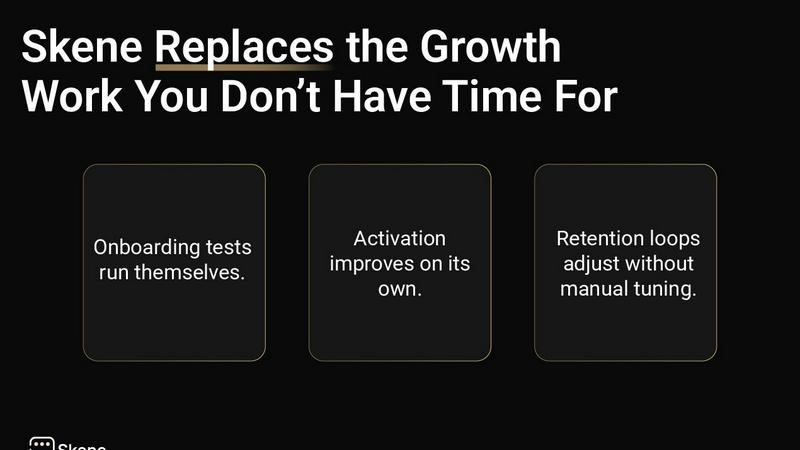
Skene acts as a fully automated iteration engine for your product's user journeys. It doesn't just create static flows; it can run A/B tests and growth experiments autonomously. The platform tests different configurations, measures outcomes based on real user data, and automatically deploys the winning variations. This creates a self-optimizing system where your product's growth infrastructure improves continuously without manual intervention.
Use Cases
ScopeSnap
Freelance Development Projects
Freelancers can use ScopeSnap to efficiently convert their discovery notes into a well-defined project scope. This helps them present clear, professional proposals to clients, thereby increasing their chances of winning projects.
Software Agency Client Engagements
Software agencies can utilize ScopeSnap to manage multiple client projects simultaneously. By standardizing the scoping process, agencies can ensure that each project begins with a clear understanding of requirements and expectations.
Collaborative Team Efforts
In scenarios where multiple team members are involved, ScopeSnap facilitates collaboration by allowing teams to refine project scopes collectively. This ensures that everyone is on the same page and contributes to the overall success of the project.
New Client Onboarding
When onboarding new clients, ScopeSnap helps agencies and freelancers streamline the process by quickly turning initial discussions into structured proposals. This speeds up the client acquisition process and builds trust from the outset.
Skene
Automated User Onboarding
For products needing to guide new users to their "aha!" moment, Skene automatically analyzes key user flows in the code and generates contextual, in-product onboarding tours. It identifies where users get stuck and creates prompts to build guides that directly address those friction points, dramatically reducing time-to-value and manual tour maintenance while improving activation rates.
Lifecycle Automation & Retention
Teams can use Skene to build automated campaigns that re-engage users based on their behavior within the product. By understanding user actions from the codebase, Skene can prompt the creation of workflows for win-back campaigns, feature adoption nudges, or re-activation sequences, turning sporadic usage into consistent engagement and reducing churn.
Data-Driven Product Iteration
Developers and product managers can leverage Skene's deep code analysis to make informed decisions. The platform identifies underutilized features, detects popular paths, and highlights UX bottlenecks directly from the application logic. This provides a clean, actionable analytics layer rooted in the product itself, guiding prioritization for the next development cycle.
AI-Agent Integrated Development
In modern AI-powered development environments like Cursor, engineers can task their AI agents with growth work. Since Skene's context and outputs are pure code, an AI agent can be prompted to analyze the growth manifest, suggest improvements, or even implement new experiments based on the latest product changes, seamlessly blending growth into the AI-assisted development loop.
Overview
About ScopeSnap
ScopeSnap is an innovative AI-powered tool designed specifically for freelance developers and software agencies, enabling them to transform chaotic discovery notes into structured project scopes, accurate estimates, and polished client-ready proposals. In the world of custom software development, effective scoping is often a daunting task. Developers frequently grapple with vague requirements, missed details, and the labor-intensive process of proposal creation. ScopeSnap addresses these challenges head-on, simplifying the entire workflow from initial discovery conversations to final proposal delivery. By leveraging advanced AI technology, ScopeSnap helps users break down complex project ideas into clearly defined, estimatable tasks, ensuring that every crucial requirement is accounted for. This not only streamlines the scoping process but also enhances client communication by providing comprehensive, well-structured proposals that instill confidence and clarity.
About Skene
Skene is an AI-powered Product-Led Growth (PLG) infrastructure designed to automate growth for software products, specifically for indie developers, early-stage startups, and engineering teams. It tackles the core challenge of the immense time and resource drain required to manually build, test, and maintain user onboarding, activation, and retention flows. This work often falls on small teams who cannot afford dedicated growth engineers, forcing them to choose between building features and building growth mechanisms. Skene's solution is deeply technical and integrated: it connects directly to your codebase and IDE, analyzing your source code to automatically understand user flows and detect friction points. Instead of relying on external, brittle scripts and third-party widgets that break with updates and create data silos, Skene generates and runs growth experiments as code you own and version. This turns your product's growth layer into a programmable, self-optimizing part of your infrastructure. Its primary value proposition is allowing builders to ship and iterate on growth loops with the same tools, workflows, and sense of ownership they use to ship product features, effectively making growth a native component of the development process.
Frequently Asked Questions
ScopeSnap FAQ
How does ScopeSnap improve project scoping?
ScopeSnap improves project scoping by using AI to convert messy discovery notes into structured tasks and requirements, ensuring clarity and accuracy in the project scope.
Can ScopeSnap handle multiple projects at once?
Yes, ScopeSnap is designed to manage multiple projects simultaneously, making it an ideal tool for freelancers and agencies working with several clients.
Is there support available for new users of ScopeSnap?
Absolutely! ScopeSnap offers comprehensive support for new users, including tutorials, documentation, and customer service to help you get started with the tool.
What types of documents can ScopeSnap generate?
ScopeSnap can generate polished proposals and Statements of Work (SOW) that are ready to be sent to clients, ensuring a professional presentation of your project scope.
Skene FAQ
How is Skene different from traditional customer experience software?
Traditional tools like Intercom or Appcues require manual, point-and-click tour creation, constant maintenance, and rely on brittle CSS selectors and UI overlays that break with every code deploy. Skene is fundamentally different: it reads your actual codebase to automatically understand your product and generate flows. When you push new code, Skene's analysis updates, and your growth mechanisms can adapt automatically, eliminating the maintenance nightmare.
How long does it take to set up?
Setup is designed to take less than 60 seconds. You simply connect your GitHub or GitLab repository with read-only access. Skene then automatically analyzes your codebase structure to generate the initial growth context and manifest. No initial code changes, API integrations, or complex configuration is required to get started.
Is my source code secure?
Absolutely. Security is a core principle. Skene only requires read-only access to your repository for analysis. This means we cannot push code or make changes. All analysis occurs in a secure, isolated environment. Your growth logic is generated as code you own and host, meaning your user data and business logic never leave your infrastructure.
What kind of analytics does Skene provide?
Skene provides an analytics dashboard focused on growth outcomes. It shows real-time user progress through key journeys, completion rates for onboarding steps, engagement metrics for features, and identifies specific bottlenecks causing drop-off. This allows you to track critical metrics like time-to-value and measure the direct impact of any growth experiments or product changes you ship.
Alternatives
ScopeSnap Alternatives
ScopeSnap is an innovative tool that utilizes artificial intelligence to streamline project scoping and proposal creation for freelance developers and software agencies. By transforming chaotic discovery notes into structured project scopes and client-ready proposals, it addresses common pain points in the estimation process, which can often be slow and fraught with risk. Users frequently seek alternatives to ScopeSnap for various reasons, including pricing, feature sets, and specific platform compatibilities that better suit their needs. When choosing an alternative, it's essential to consider the tool's ability to facilitate clear task breakdowns, provide accurate estimates, and generate polished proposals efficiently, ensuring that it aligns with your workflow and project requirements.
Skene Alternatives
Skene is an AI-powered PLG (Product-Led Growth) infrastructure tool in the productivity and management category. It automates growth by analyzing your codebase and running self-optimizing experiments, turning growth into a programmable layer of your product. Users often seek alternatives for various reasons. Some may need a different pricing model or a free tier to start. Others might require a platform that integrates with specific tools or offers a less technical, more visual interface for non-developers. The need for a different feature set, such as more traditional analytics or manual A/B testing tools, can also drive the search. When evaluating alternatives, consider your core needs. Look for a solution that aligns with your team's technical expertise, integrates smoothly with your existing stack, and scales with your product. The right tool should effectively reduce the manual burden of growth tasks, whether through automation, better insights, or streamlined workflows.