
About DeepRails
DeepRails is the definitive AI reliability and guardrails platform engineered for development teams determined to ship trustworthy, production-grade AI systems. The core challenge with integrating large language models (LLMs) into real applications is their propensity for "hallucinations"—generating confident but incorrect or ungrounded information. This issue erodes user trust and blocks enterprise adoption. DeepRails directly solves this by providing a comprehensive suite that not only detects these critical errors with high precision but also actively fixes them before flawed outputs reach end-users. Built by AI engineers for AI engineers, it is a model-agnostic platform that integrates seamlessly into modern development pipelines. It empowers teams to move beyond merely monitoring for problems to implementing substantive, automated corrections. With capabilities like custom evaluation metrics, human-in-the-loop feedback, and detailed analytics, DeepRails provides complete AI quality control, enabling businesses in sensitive sectors like legal, finance, and healthcare to deploy AI with confidence and stand behind every response.
Features of DeepRails
Defend API: Real-Time Correction Engine
The Defend API is your real-time AI correction engine. It acts as a kill-switch for hallucinations, automatically identifying quality issues and fixing them before they reach your customers. You configure guardrail metrics and thresholds, and the API will score your model's output, then trigger automated improvement actions like "FixIt" or "ReGen" to correct detected hallucinations, ensuring only verified, high-quality responses are delivered.
Expansive Library of Guardrail Metrics
DeepRails offers a comprehensive library of precise, granular evaluation metrics. Choose from general-purpose metrics like Correctness, Completeness, and Context Adherence, or create custom ones tailored to your domain. Each metric provides a 0-100 score, with DeepRails claiming significant accuracy advantages over alternatives like AWS Bedrock for detecting factual inaccuracies and other critical failures in AI outputs.
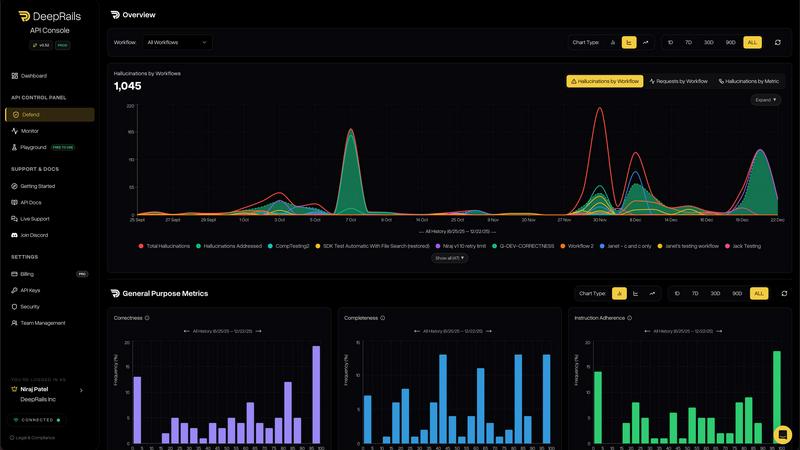
DeepRails Console for Analytics & Audit
Every interaction processed by DeepRails is logged in real-time, flowing into a comprehensive console. This provides beautiful metrics, detailed traces, and full audit logs. You can track performance metrics, monitor improvement chains, and drill into any individual run to understand exactly what happened, from your LLM's initial output through DeepRails' evaluation and any corrective actions taken.
Model-Agnostic & Seamless Integration
Built specifically for developers, DeepRails is designed to integrate smoothly into existing development and deployment pipelines. It is model-agnostic, working with any LLM, and offers SDKs and a straightforward API. This allows engineering teams to implement robust guardrails without overhauling their entire AI stack, moving quickly from setup to shipping more reliable applications.
Use Cases of DeepRails
Legal & Compliance Applications
In the legal domain, where citing non-existent cases or misstating rulings can have severe consequences, DeepRails is critical. It ensures every legal citation and piece of advice is factually accurate and grounded in provided context. The platform can verify case law references and filter out unsubstantiated claims, allowing firms to deploy AI-assisted research and drafting tools with confidence.
Financial Services & Advisory
For financial institutions providing automated advice, reports, or market summaries, accuracy is non-negotiable. DeepRails guards against hallucinations that could suggest incorrect financial data, flawed investment strategies, or misrepresented regulations. It ensures all outputs are complete, adhere to strict compliance instructions, and are based solely on verified source material.
Healthcare Information Systems
Healthcare applications demand extreme factual precision. DeepRails can verify drug interaction lists, validate treatment information against medical guidelines, and ensure patient advice is safe and complete. By detecting and correcting medical hallucinations, it enables the deployment of AI tools that support professionals without risking patient safety through misinformation.
Robust RAG (Retrieval-Augmented Generation) Systems
For any application using RAG architecture, ensuring the LLM's output strictly adheres to the provided source documents is paramount. DeepRails' Context Adherence metric specifically evaluates whether each factual claim is supported by the retrieved context, preventing the model from "going rogue" and inventing information, thereby guaranteeing the integrity of the knowledge-grounded system.
Frequently Asked Questions
What exactly does DeepRails fix?
DeepRails primarily fixes "hallucinations," which are instances where an AI model generates confident but incorrect, ungrounded, or irrelevant information. It detects these failures using customizable metrics and can then automatically trigger corrective actions, such as rewriting the flawed part of the response or regenerating a new answer, before the bad output is sent to your end-user.
How is DeepRails different from basic LLM output monitoring?
Basic monitoring might alert you after a problem has reached a user. DeepRails moves beyond passive monitoring to active prevention and correction. It acts as an in-line guardrail that evaluates, scores, and can fix problematic outputs in real-time. It also provides a much deeper, metric-driven analysis and full audit trail, not just simple alerts.
Do I need to change my LLM or AI model to use DeepRails?
No. A core feature of DeepRails is that it is model-agnostic. It works with any large language model (like GPT-4, Claude, Llama, or your custom fine-tuned model) by analyzing the text output and the associated context. You integrate it into your application's workflow via API, and it evaluates and processes the responses from your existing LLM setup.
Can I create custom evaluation metrics for my specific needs?
Yes. While DeepRails provides a powerful library of pre-built metrics for correctness, safety, and more, it also allows you to define custom guardrail metrics tailored to your unique domain, business rules, or quality standards. This flexibility ensures you can enforce the specific criteria that matter most for your application's reliability and trustworthiness.