
Rock Smith
Rock Smith uses AI to automate QA testing by simulating real user behavior for reliable software.
Visit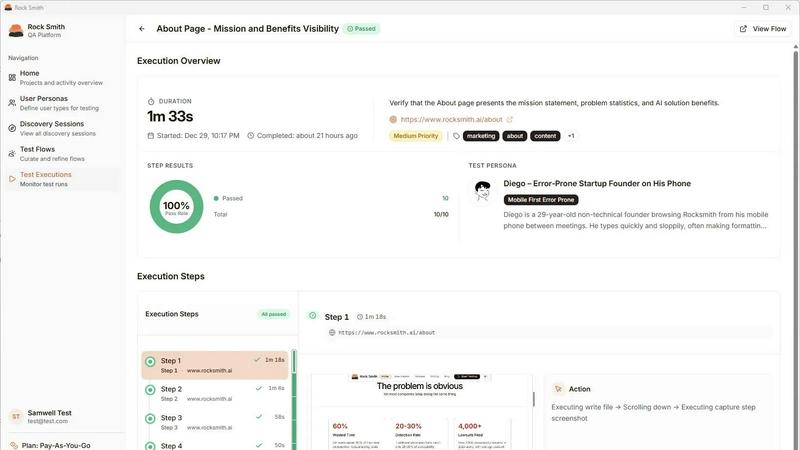
About Rock Smith
Rock Smith is an innovative AI-powered testing solution designed to solve the critical challenge of maintaining reliable, automated quality assurance for modern web applications. Traditional test automation, reliant on brittle CSS selectors and XPath expressions, creates a massive maintenance burden. Every minor UI tweak, from moving a button to changing a class name, can break dozens of tests, forcing engineering teams to choose between constant debugging and letting their test suite become obsolete. This problem stalls development velocity and risks software quality, especially for fast-moving teams.
Rock Smith directly addresses this by replacing fragile code-based selectors with autonomous AI agents that interact with your application as a real user would. Its core innovation is semantic element targeting, where UI components are described by their visual appearance and contextual meaning—like "the blue Submit button below the login form." This human-like understanding allows tests to self-heal when the UI evolves, dramatically reducing maintenance overhead. It empowers QA professionals, developers, and business leaders to automate comprehensive black-box testing efficiently, ensuring high-quality software delivery without the hassle. Rock Smith transforms QA from a bottleneck into a seamless, integrated part of the development lifecycle, letting teams build and ship with confidence.
Features of Rock Smith
Autonomous AI Testing Agents
Rock Smith deploys intelligent AI agents that autonomously navigate and test your web application. These agents simulate real user behavior, performing actions like clicking, typing, and scrolling without relying on pre-scripted, brittle selectors. This eliminates the need for manual test script creation and maintenance for common user flows, freeing your team to focus on more complex testing scenarios and product development.
Semantic Element Targeting
This revolutionary feature moves beyond traditional automation techniques. Instead of targeting elements with fragile CSS or XPath, Rock Smith uses natural language descriptions of UI components based on their visual and contextual properties. For example, it can identify "the shopping cart icon in the top right navbar" or "the error message in red text." This approach makes tests inherently resilient to UI changes, as the AI adapts to find the described element even if its underlying code changes.
Self-Healing Test Capabilities
The most significant maintenance challenge in test automation is broken tests due to UI updates. Rock Smith's semantic understanding and AI-driven execution enable tests to self-heal. When a UI element changes location, color, or label, the AI re-interprets the semantic description to find the new matching element, keeping your test suite functional and reliable with minimal manual intervention.
Streamlined Workflow for Fast-Moving Teams
Rock Smith is built for velocity. It provides a centralized platform where QA professionals, developers, and even business stakeholders can define, execute, and review tests without deep coding expertise. This collaboration ensures quality is baked into the process from the start, enabling continuous testing and integration that keeps pace with rapid development cycles and frequent deployments.
Use Cases of Rock Smith
Continuous Regression Testing for Agile Teams
For teams practicing CI/CD with frequent releases, manual regression testing is impossible. Rock Smith automates end-to-end user journey tests after every build. Its self-healing nature ensures the regression suite remains robust through UI iterations, providing instant feedback on breaking changes and protecting core functionality without slowing down the release train.
Rapid Test Creation for New Features
When launching new features, QA teams need to build test coverage quickly. Rock Smith allows testers to describe new user flows in plain language, and its AI agents automatically generate and execute the corresponding tests. This drastically reduces the time-to-test for new functionality, ensuring quality gates are met without delaying go-live dates.
Reducing QA Maintenance Overhead
Teams burdened by maintaining thousands of flaky, selector-based Selenium tests can use Rock Smith to modernize their approach. By converting critical test cases to use semantic targeting, teams can slash the time spent on debugging broken locators by over 70%, reallocating QA resources to higher-value exploratory testing and quality initiatives.
Enabling Developer-Led Testing (Shift-Left)
Rock Smith empowers developers to write meaningful integration tests for their own features before handing them off. Using natural language descriptions, developers can quickly script tests that mimic user interaction, catching bugs early in the development cycle. This shift-left approach improves code quality and reduces the cost of fixing defects.
Frequently Asked Questions
How does Rock Smith differ from traditional tools like Selenium?
Traditional tools like Selenium rely on static, code-based locators (CSS/XPath) that break when the UI HTML structure changes. Rock Smith uses AI and semantic understanding to describe and find elements by how they look and behave to a user, not by their underlying code. This makes Rock Smith tests far more resilient to changes and reduces maintenance by over 70%.
Do I need programming skills to use Rock Smith?
No, that's a key advantage. While technical users can leverage advanced options, the core functionality is designed to be accessible. You define tests by describing user actions and UI elements in plain English (e.g., "click the login button"), making it usable for QA analysts, product managers, and developers alike without deep coding expertise.
Can Rock Smith handle complex, dynamic web applications?
Yes. Rock Smith's AI agents are built to interact with modern, JavaScript-heavy single-page applications (SPAs) and dynamic content. The semantic targeting system understands contextual relationships and can wait for elements to appear, handle pop-ups, and navigate complex state changes just like a human user would.
Is my application data secure with Rock Smith?
Security is a top priority. Rock Smith operates as a black-box testing tool, interacting only with the publicly facing front end of your application, typically in a staging or test environment. It does not require direct database access or back-end credentials. You maintain full control over which environments are tested and what data is used.
Pricing of Rock Smith
Rock Smith offers a tiered pricing model designed for different team sizes and needs. You can start with a free plan to explore core features. For professional use, the Solo Pro plan at $10 per month (billed yearly) is tailored for founders and solopreneurs, offering unlimited projects, custom AI experts, and detailed implementation plans. For collaborative teams, the Band plan supports up to 5 human collaborators in addition to AI experts, with features for shared projects and workflow integration, enabling startups and teams to scale their testing efforts efficiently.