
Unicode to Bamini Converter
Instantly convert modern Unicode Tamil text to the classic Bamini font encoding for compatibility with legacy systems and documents.
Visit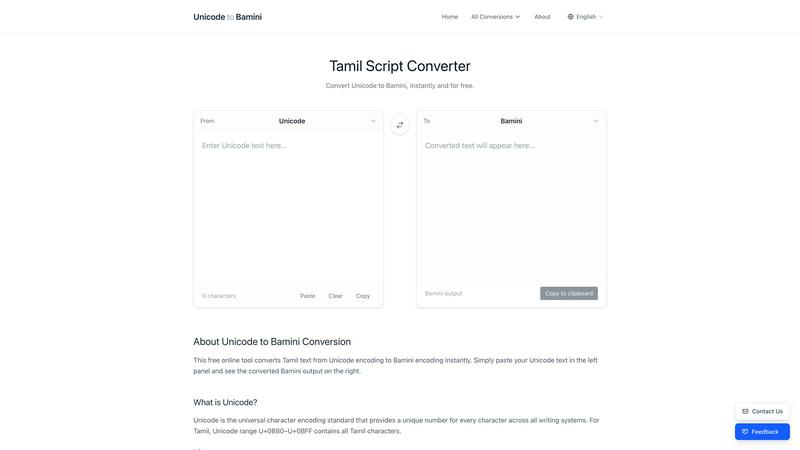
About Unicode to Bamini Converter
The Unicode to Bamini Converter is a vital, web-based solution designed to bridge the gap between modern and legacy Tamil computing. It tackles a pervasive problem: thousands of important Tamil documents, from newspaper archives to literary works and official records, are trapped in outdated font encodings like Bamini and TSCII. These files become unreadable or display as garbled text on modern systems without the specific, often hard-to-find, fonts installed. This tool instantly converts text between Unicode, the universal modern standard, and over 25 legacy Tamil encodings, with Bamini being a primary focus due to its historical prevalence, especially in Sri Lanka.
This converter is engineered for Tamil publishers, journalists, archivists, content creators, developers, and researchers. Its core value proposition is liberation and accessibility. It empowers users to unlock legacy content by converting it to future-proof Unicode, ensuring it can be viewed, shared, and edited on any device or platform. Conversely, it allows for the creation of Bamini-encoded text to maintain compatibility with older systems or document sets. By providing instant, accurate, and free conversion without any software installation, it removes a significant technical barrier, preserving Tamil digital heritage and facilitating seamless work across different eras of technology.
Features of Unicode to Bamini Converter
Extensive Encoding Support
This tool is not limited to just Bamini and Unicode. It functions as a comprehensive hub for Tamil text conversion, supporting over 25 different font encodings including TSCII, Anjal, TAB, Dinamani, and Murasoli. This wide coverage ensures that regardless of the legacy format you encounter—be it from a 1990s word processor file or an old website—you have a direct path to convert it into usable, modern Unicode text, and vice versa, all within a single, unified interface.
Real-Time, Instant Conversion
The converter operates with seamless efficiency. The moment you paste or type your text into the source panel, the conversion happens immediately without requiring a page reload or a submit button. This real-time processing provides a fluid, interactive experience, allowing you to see changes and verify accuracy on the fly. It dramatically speeds up workflow, whether you're converting a single paragraph or an entire document, making the process feel instantaneous.
Complete Character Mapping Reference
Transparency and accuracy are paramount. For every encoding pair, such as Bamini to Unicode, the tool provides a complete, accessible character mapping table. This table acts as a definitive reference guide, showing exactly which character or code point in one system corresponds to another. This feature is crucial for developers verifying conversion logic, researchers studying encoding schemes, and any user who needs to understand or troubleshoot the transformation process at a granular level.
Cross-Platform & Multilingual Accessibility
Designed for universal access, the converter requires no downloads or installations. It runs directly in your web browser on any desktop, laptop, tablet, or smartphone. Furthermore, recognizing the diverse user base, the interface is available in five languages: English, Tamil, Sinhala, Hindi, and Chinese. This eliminates language as a barrier, making the tool genuinely accessible to Tamil speakers and professionals across the globe, regardless of their primary language.
Use Cases of Unicode to Bamini Converter
Digitizing Legacy Archives and Newspapers
Publishers, libraries, and historians face the challenge of digitizing old Tamil newspapers, magazines, and books typed in Bamini or TSCII. These archives are digitally inaccessible. Using this converter, they can batch-process or manually convert these documents to Unicode. This unlocks the content for modern digital libraries, online archives, and research databases, ensuring historical and cultural records are preserved and searchable for future generations without font dependencies.
Modernizing Content for Websites and Apps
Web developers and content managers often inherit or need to integrate older Tamil content into new websites, blogs, or mobile applications. If the source material is in a legacy encoding like Anjal or Dinamani, it will not display correctly online. This tool allows them to quickly convert all text assets to standard Unicode (UTF-8), guaranteeing consistent and correct rendering across all browsers and devices for their audience.
Academic Research and Linguistic Analysis
Researchers and linguists working with Tamil corpora frequently encounter data sets in various non-standard encodings. To analyze text, apply computational tools, or compare sources, they need everything in a consistent format. This converter enables them to normalize all text into Unicode, facilitating tasks like frequency analysis, concordance creation, and computational linguistics studies that would otherwise be hampered by incompatible encoding schemes.
Maintaining Compatibility with Legacy Systems
In certain government offices, publishing houses, or organizations, critical legacy software systems may only accept or output text in a specific format like Bamini. When new content is created in Unicode, staff can use this converter to transform it into the required legacy encoding for input into those systems. This ensures operational continuity without forcing a costly and immediate upgrade of the entire software infrastructure.
Frequently Asked Questions
What is the difference between Unicode and Bamini encoding?
Unicode is an international standard that assigns a unique code point to every character in almost every writing system, including Tamil. It is platform-independent and ensures text looks the same everywhere. Bamini, in contrast, is a proprietary font encoding that uses standard ASCII keys (like 'm' for 'அ') to represent Tamil characters. It requires the specific Bamini font to be installed to display correctly, whereas Unicode text uses any standard Tamil-supporting font.
Is my text data safe when I use this converter?
Yes. The Unicode to Bamini Converter is a client-side tool, meaning the conversion logic runs entirely within your web browser. Your text is not sent to or stored on any external server for processing. As soon as you close the browser tab or clear the input fields, the data is gone. This design prioritizes user privacy and data security, especially important when handling sensitive or proprietary documents.
Can I convert entire documents, or is there a text limit?
The tool is designed for practical use with substantial text. While there is no strict, advertised character limit for the web interface, it is optimized for converting large passages, articles, and even full chapters seamlessly. For extremely large documents (like entire books), it may be more manageable to break them into sections. The real-time processing handles thousands of characters effortlessly for typical use cases.
Why would I need to convert from Unicode back to Bamini?
While converting to Unicode is most common for modernization, converting from Unicode back to Bamini is necessary for specific legacy workflows. This includes updating or adding to existing Bamini-encoded archives, preparing text for input into older publishing software that only accepts Bamini, or ensuring consistency when collaborating with parties who still operate within a legacy Bamini-based ecosystem.
Explore more in this category:
Similar to Unicode to Bamini Converter
Wordy
Learn languages with real movie and TV show clips.
YT Video Summarizer
Turn Long YouTube Videos into Quick AI Summaries in Seconds.
MeloLingua
MeloLingua transforms language learning by using personalized stories to boost confidence and fluency from day one.
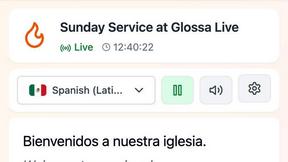
Glossa
Glossa provides real-time AI translation of sermons in over 100 languages, enabling churches to connect globally.
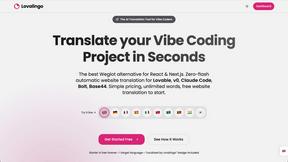
Lovalingo
Translate and index your React apps in seconds with seamless, zero-flash localization and automated SEO features.
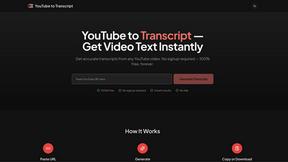
YouTube to Transcript
100% Free YouTube transcript extractor supporting translation in 125+ languages. No login or limits.

Pathoura
Pathoura creates instant multilingual audio guides for museums using visitors' own smartphones.
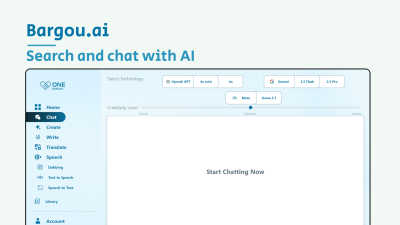
Bargou One
Stop language and creation barriers with Bargou One's all-in-one AI toolkit for writing, translating, and transcribing.