
SALBCALC
Stop guessing and start pouring with Salbcalc, the free online concrete calculator that instantly delivers precise volume, bag count, weight, and.
VisitPublished on:
July 13, 2026
Pricing:
About SALBCALC
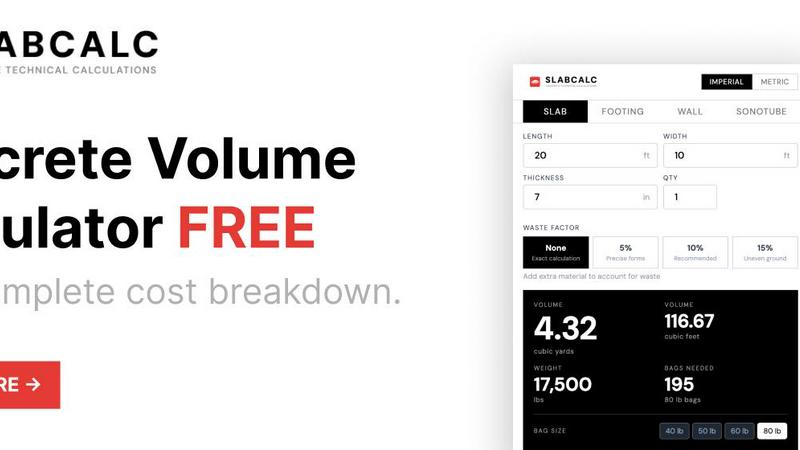
SALBCALC is a free, no-signup concrete calculator designed for contractors, builders, and DIYers who need fast, accurate concrete estimates without the hassle of account creation or software downloads. The tool addresses the core challenge of concrete planning: calculating the exact volume, bag count, and cost for any project type, from simple slabs and footings to complex stairs and curbs. Users simply pick their project shape, enter dimensions in either imperial or metric units, and instantly receive total volume in cubic yards and cubic meters, the number of pre-mix bags needed at any common weight (40, 50, 60, or 80 lb), estimated total weight, and a project cost estimate. A built-in waste factor slider (0%, 5%, 10%, or 15%) accounts for spillage and uneven ground, ensuring the order quantity matches what actually gets poured. Beyond the calculator, SALBCALC publishes guides, project-cost references, and an analyze feature for larger projects, making it a one-stop reference for concrete planning. The tool solves the critical problem of over-ordering or running short on a pour, which can lead to expensive truck returns, cold joints, and wasted materials. By providing instant, accurate estimates, SALBCALC empowers users to budget confidently, order the right amount of concrete, and avoid costly mistakes on any project size.
Features of SALBCALC
Multi-Shape Project Support
SALBCALC supports nine distinct shape types including slabs, cylinders, curbs, stairs, columns, walls, footings, circles, and tubes. This versatility means you can calculate concrete needs for virtually any project structure, from a simple patio slab to a complex staircase or a cylindrical column. Each shape type has tailored input fields and calculation logic, ensuring accuracy regardless of your project's geometry. No more manual formulas or guesswork for different shapes.
Instant Volume and Bag Count Calculations
Enter your dimensions and instantly receive total volume in cubic yards and cubic meters, plus the exact number of pre-mix bags needed at 40, 50, 60, or 80 lb weights. The tool also calculates estimated total weight and provides a project cost estimate. This eliminates time-consuming manual math and reduces the risk of ordering the wrong amount of concrete, saving both time and money on every project.
Built-in Waste Factor Adjustment
A waste factor slider lets you select 0%, 5%, 10%, or 15% extra concrete to account for spillage, uneven ground, and over-excavation. The tool automatically adds this percentage to your calculated volume, ensuring your order quantity matches what actually gets poured. This feature solves the common problem of running short on a pour, which can cause expensive delays and cold joints that are difficult to repair cleanly.
Dual Unit System Support
SALBCALC supports both imperial (feet, inches, yards) and metric units, allowing users anywhere in the world to work in their preferred measurement system. This flexibility is critical for international projects or when working with plans from different sources. The tool automatically converts and displays results in both cubic yards and cubic meters, providing a comprehensive view of your concrete requirements.
Use Cases of SALBCALC
Residential Patio and Walkway Planning
A homeowner planning a 10x10 foot patio at 4 inches thick can use SALBCALC to instantly determine they need 0.62 cubic yards of concrete, which translates to 28 bags of 80-lb mix or 37 bags of 60-lb mix. By adding the recommended 10% waste factor, they ensure they have enough material for subgrade irregularities and spillage. The cost estimate feature helps them compare bagged concrete versus ready-mix delivery, guiding them to the most economical choice for their project volume.
Commercial Driveway and Slab Estimation
A contractor bidding on a 20x40 foot driveway at 5 inches thick can quickly calculate the total volume (4.94 cubic yards), bag count (224 bags of 80-lb), and estimated material costs. The analyze feature helps break down larger project costs, while the waste factor adjustment accounts for uneven ground conditions common in commercial sites. This enables accurate quotes and material ordering, preventing costly overruns or shortages on the job.
Column and Footing Calculations for Deck Building
A builder constructing a deck with 12-inch diameter footings at 48 inches deep can use the cylinder shape calculator to determine exactly how many bags of concrete are needed per footing. The tool instantly shows that each footing requires about 6 bags of 80-lb concrete. By inputting the quantity of footings, the builder gets a total project estimate, ensuring they order enough material without excess waste.
Staircase and Curb Construction Planning
A contractor pouring concrete stairs or curbs can use the dedicated shape calculators to get precise volume and bag counts for these complex structures. The tool accounts for the unique geometry of stairs (treads and risers) and curbs (height, width, and length), providing accurate estimates that manual calculations often miss. This prevents ordering errors that can delay a project or result in expensive material returns.
Frequently Asked Questions
How do I calculate the volume of a rectangular concrete slab?
Use the formula: Length (ft) x Width (ft) x Thickness (ft) divided by 27 equals Cubic Yards. Convert thickness from inches to feet first by dividing by 12. For example, a 4-inch slab is 4 divided by 12, which equals 0.333 feet. Multiply length by width by thickness in feet, then divide by 27 to get cubic yards. SALBCALC does this automatically for you.
Should I use bagged concrete or ready-mix for my project?
For projects under 1 cubic yard, bagged concrete is the practical choice because it is available at any hardware store and requires no truck coordination. Once you cross the 1-yard mark, ordering ready-mix from a plant is faster, cheaper per unit, and results in a more consistent mix. SALBCALC provides cost estimates for both options to help you decide.
Why should I add a waste factor to my concrete order?
Always order 10% more concrete than your calculated volume because subgrade irregularities, spillage, and slight over-excavation add up quickly. Running short on a pour is expensive because the truck has to return, and a cold joint in a finished slab is difficult to repair cleanly. SALBCALC's built-in waste factor slider automatically adds the recommended percentage to your order quantity.
What is the standard thickness for different concrete slabs?
Residential patios and sidewalks are typically poured at 4 inches thick. Driveways that carry vehicle weight should be 5 to 6 inches thick. Structural slabs, garage floors, and any slab with heavy load requirements may call for 6 inches or more with rebar reinforcement. SALBCALC allows you to input any thickness in inches or metric units for precise calculations.
Similar to SALBCALC

Wheel of Names Picker AI
Wheel of Names Spin Wheel Picker tool for classrooms or events
Snapkin
Snapkin is a calorie tracker you use by photographing your plate.

imgtxtapp.laviolab.com
imgtxtapp.laviolab.com is a Telegram-based image-to-text converter that turns photos, screenshots, scanned documents into editable text
PythonExercise.com
An interactive coding platform featuring bite-sized Python exercises designed to build real coding skills through hands-on practice.

PracticeSIEM
PracticeSIEM.com is an interactive, browser-based hands-on cybersecurity learning platform designed for Security Operations Center (SOC) analysts.
SQLCrab
SQLCrab (sqlcrab.com) is an interactive, browser-based SQL learning platform that lets you practice database queries directly in your browser.


GetYouTubeTranscript
Free YouTube transcripts on the web, a Chrome extension, and an API + MCP server so AI assistants can read YouTube.