Social Fetch
Stop scraping social data manually and use Social Fetch to get profiles, posts, and metrics from 17 platforms with one reliable API.
Visit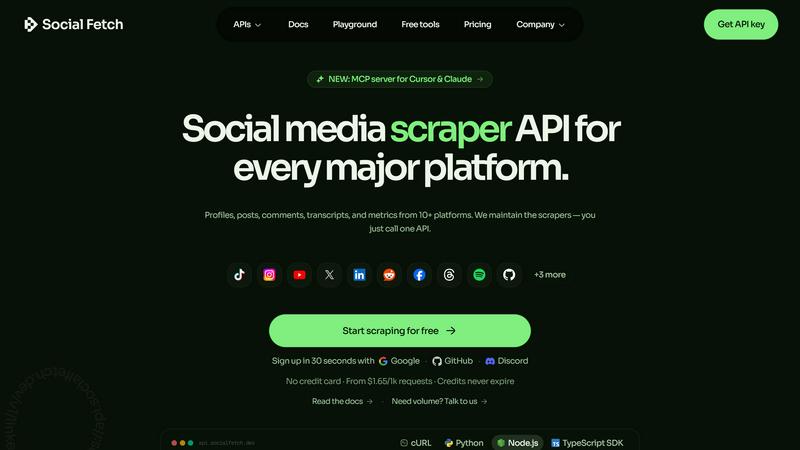
About Social Fetch
Social Fetch is a purpose-built social media scraper API designed for developers who need reliable, structured public data from multiple social platforms without the headache of maintaining fragile HTML parsers or managing proxy farms. With a single API key, you unlock access to TikTok, Instagram, YouTube, Twitter/X, LinkedIn, and 15+ additional networks through consistent REST endpoints and normalized JSON schemas. This means your team can extract profiles (including bios, avatars, follower counts, and verification status), posts and reels (captions, media URLs, likes, and comment counts), comments and threads, engagement metrics, video transcripts, and hashtag or keyword search results—all returned as typed JSON ready for immediate consumption in your applications. Social Fetch includes an OpenAPI specification, quickstart guides, and a TypeScript SDK that cuts integration time from weeks down to hours. Unlike generic web scraping APIs, Social Fetch is built specifically for social platforms: field names are normalized across networks, pagination uses consistent cursor patterns, every response includes an explicit lookupStatus outcome, and error codes are documented and predictable. For AI workflows, a hosted MCP server allows agents in Cursor and Claude to query live social data with structured outputs. Billing is credit-based and pay-as-you-go, starting with 100 free credits and scaling from $1.65 per 1,000 requests with no subscription lock-in and a measured 99.8% uptime. Social Fetch is the social data API that production teams choose when marketplace scrapers change pricing or disappear overnight.
Features of Social Fetch
Unified API Across 17+ Platforms
One API key and one consistent REST pattern gives you access to TikTok, Instagram, YouTube, Twitter/X, LinkedIn, and 15+ additional social networks. Every endpoint returns the same JSON schema structure with normalized field names, so you never need to write platform-specific parsers or handle different data formats. This dramatically reduces development time and maintenance burden when your application needs data from multiple social sources.
Structured JSON Responses with Typed Schemas
Every API call returns typed JSON with explicit fields for profiles (bios, avatars, follower counts, verification), posts and reels (captions, media URLs, likes, comment counts), comments, threads, engagement metrics, video transcripts, and search results. The response includes a lookupStatus field so your pipeline can reliably determine whether data was found, is partial, or failed, and documented error codes mean you can handle issues programmatically without guessing.
Hosted MCP Server for AI Agents
Social Fetch provides a hosted Model Context Protocol server that lets AI agents in environments like Cursor and Claude query live social data with structured outputs. This means your AI workflows can directly fetch real-time profile information, recent posts, or engagement metrics without writing additional integration code or managing separate API calls, making it ideal for building AI-powered research, monitoring, or content generation tools.
Credit-Based Billing with No Subscription Lock-In
Billing is entirely pay-as-you-go with credits that never expire. You start with 100 free credits and no credit card required, then scale from $1.65 per 1,000 requests. There are no monthly subscriptions, no surprise overage fees, and you only pay for what you use. With a measured 99.8% uptime and infrastructure that handles rate limits and proxy management, you can trust Social Fetch in production without negotiating limits or worrying about platform changes.
Use Cases of Social Fetch
Social Media Monitoring and Brand Tracking
Marketing teams and agencies can continuously monitor brand mentions, competitor activity, and industry trends across multiple platforms. By fetching profiles, posts, and engagement metrics from TikTok, Instagram, Twitter, and YouTube through a single API, you can build dashboards that track follower growth, post performance, and sentiment in real time without maintaining separate scrapers for each network.
AI Training Data Collection and Enrichment
Machine learning teams needing large volumes of structured social data for training models can use Social Fetch to collect profiles, posts, comments, and transcripts at scale. The normalized JSON output means data is immediately compatible with your data pipelines, and the consistent schema across platforms reduces preprocessing work. The MCP server integration also allows AI agents to fetch live data for enrichment during inference.
Influencer Research and Vetting
Agencies and brands researching potential influencer partners can quickly pull profile data including follower counts, verification status, bio information, and engagement metrics from Instagram, TikTok, YouTube, and Twitter. The API returns structured data that can be compared and analyzed programmatically, allowing you to build automated vetting workflows that assess influencer fit and authenticity without manual research.
Competitive Intelligence and Market Research
Product teams and analysts can gather public data on competitor social media presence, including post frequency, engagement rates, follower growth, and content strategies. By searching hashtags or keywords across multiple platforms and fetching profile data, you can build competitive benchmarks and identify market opportunities. The cursor pagination makes it easy to collect large datasets for longitudinal analysis.
Frequently Asked Questions
What platforms does Social Fetch support?
Social Fetch supports TikTok, Instagram, YouTube, Twitter/X, LinkedIn, and 15+ additional social networks. The full list is documented in the API specification, and the team regularly adds new platforms based on developer demand. All platforms are accessible through the same REST API with consistent JSON schemas.
How does the credit-based pricing work?
You start with 100 free credits after signing up, no credit card required. Each API request consumes credits based on the endpoint and data complexity, with pricing starting at $1.65 per 1,000 requests at scale. Credits never expire, so you only pay for what you use with no monthly subscription fees or lock-in contracts.
Is Social Fetch reliable for production use?
Yes. Social Fetch maintains a measured 99.8% uptime and handles rate limits, proxy rotation, and scraper maintenance internally. The API includes explicit lookupStatus outcomes and documented error codes so your production pipelines can handle failures programmatically. You are never charged for infrastructure failures on Social Fetch's side.
Can I use Social Fetch with AI agents and tools?
Yes. Social Fetch provides a hosted MCP server that integrates with AI environments like Cursor and Claude, allowing AI agents to query live social data with structured outputs. This makes it easy to build AI-powered research tools, monitoring systems, or content generation workflows that need real-time social media data.
Explore more in this category:
Similar to Social Fetch
SightRadar
Face recognition API, a drop-in replacement for AWS Rekognition. Index, search, compare and detect faces, billed per photo with no subscription.

Orlyn
Privacy-first, cookieless web analytics that ties your traffic and marketing channels to real Stripe revenue.
BillionVerify
BillionVerify is a professional email verification service built to solve one problem: bad email data costs businesses money.

Genjutsu AI
Genjutsu AI turns your ideas into cinematic videos, product ads, social shorts, and high-quality images in minutes.

TrackMedia
Publish to 20 social networks from one composer and track every click in real time. Built for humans and AI agents.

CubexSoft EML Converter
Convert EML Files to PST, PDF, EML, MBOX, CSV, Gmail, IMAP, Thunderbird, and more.
GetYouTubeTranscript
Free YouTube transcripts on the web, a Chrome extension, and an API + MCP server so AI assistants can read YouTube.